


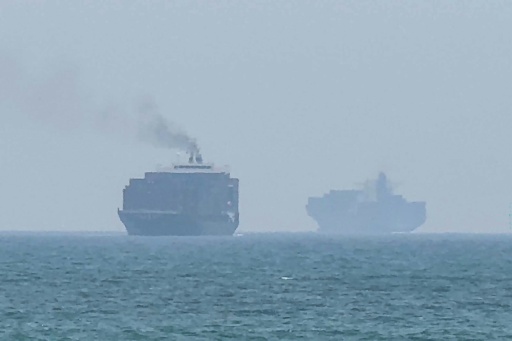
Six months since the start of the Middle East war, the strategic Strait of Hormuz remains largely paralysed, with thousands of sailors still stranded in the Gulf and commodity carrier traffic way below its normal level.
Before Iran blocked the strait in response to joint US-Israeli strikes in February, around one fifth of the world's oil and liquefied natural gas exports passed through the waterway.
Iran's Guards have also warned of a "danger zone" covering 1,400 square kilometres where mines may be present.
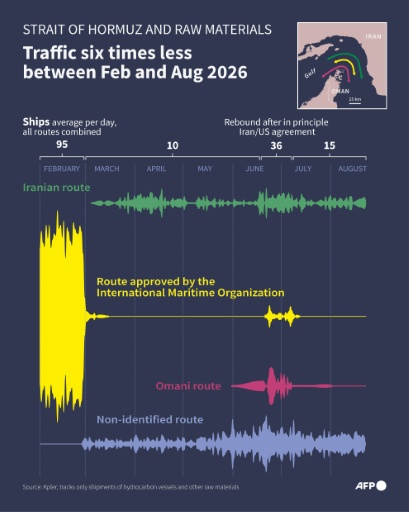
After Iran closed the strait on March 1, commodity carrier traffic plummeted to an average of 10 transits per day, compared with a daily average of 95 in February, according to an AFP analysis of data from maritime tracker Kpler.
An agreement signed by the United States and Iran in June led to a temporary rebound to 36 transits per day, before they dropped back to an average of 15 between the resumption of hostilities on July 8 and August 22.
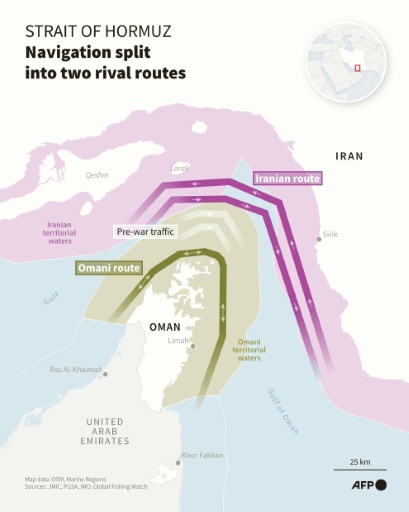
Before the war, vessels crossed the strait freely via a route through the centre of the waterway adopted by the International Maritime Organization (IMO).
There are now two distinct routes: one to the north, near the Iranian coast -- the only one approved by Tehran -- and another to the south, between the Omani coast and potentially mined areas.
During the relatively calm period between June 17 and July 7, an average of nine ships per day used the Iranian route and eight the Omani one. The rest transited via unidentified routes or the traditional IMO corridor.
Ever since the ceasefire collapsed on July 8, two-thirds of transits have become "dark", or unknown, compared with less than one percent before the war, according to Kpler.
These transits involve vessels whose exact route cannot be confirmed due to insufficient data stemming from disabled transponders, jammed signals or missing satellite imagery.
Some 6,000 sailors and 500 ships have remained stuck in the Gulf since the beginning of the conflict, the IMO told AFP.
The organisation said there were "ongoing discussions" to ensure a secure maritime route, adding that their outcome "depends on de-escalation in the region".
The IMO had begun an initiative in June to evacuate more than 11,000 seafarers stuck in the Gulf, but the effort was soon suspended following an attack on a vessel.
Over the past six months, at least 20 sailors and dockworkers have been killed in incidents or attacks in the region, according to the IMO.
Latest stories
Monde "Tant que le corps tient": le travail sans relâche d'un secouriste, deux mois après le séisme au Venezuela
Deux mois après le double séisme qui a frappé le Venezuela, la mission que s'est donnée Domingo Pacheco, un secouriste bénévole arrivé dans la zone sinistrée dès le premier...

La Une Les Etats-Unis visent "l'asphyxie économique" de l'Iran et menacent les alliés de Téhéran
Le gouvernement américain a affirmé lundi sa volonté de "couper toutes les ressources économiques" de l'Iran et adressé un avertissement ferme aux pays qui continueraient à soutenir Téhéran, qui voit...

Sport Roger Federer de retour à l'US Open pour "dire merci", sept ans après
Roger Federer est de retour à l'US Open: le maître des lieux jouera mardi à New York lors d'un match d'exhibition sur le célèbre court Arthur Ashe, où...