


Six months since the start of the Middle East war, the strategic Strait of Hormuz remains largely paralysed, with thousands of sailors still stranded in the Gulf and commodity carrier traffic way below its normal level.
Before Iran blocked the strait in response to joint US-Israeli strikes in February, around one fifth of the world's oil and liquefied natural gas exports passed through the waterway.
Iran's Guards have also warned of a "danger zone" covering 1,400 square kilometres where mines may be present.
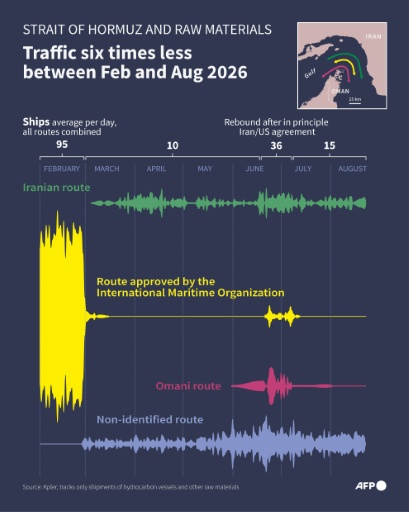
After Iran closed the strait on March 1, commodity carrier traffic plummeted to an average of 10 transits per day, compared with a daily average of 95 in February, according to an AFP analysis of data from maritime tracker Kpler.
An agreement signed by the United States and Iran in June led to a temporary rebound to 36 transits per day, before they dropped back to an average of 15 between the resumption of hostilities on July 8 and August 22.
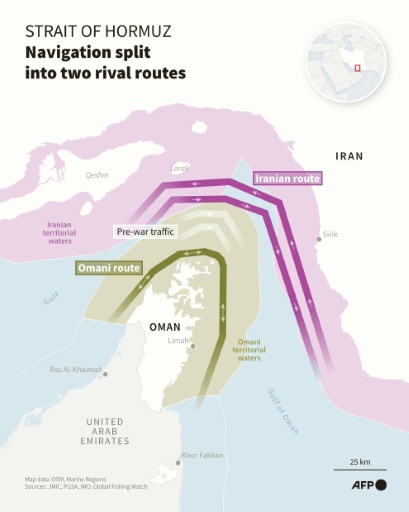
Before the war, vessels crossed the strait freely via a route through the centre of the waterway adopted by the International Maritime Organization (IMO).
There are now two distinct routes: one to the north, near the Iranian coast -- the only one approved by Tehran -- and another to the south, between the Omani coast and potentially mined areas.
During the relatively calm period between June 17 and July 7, an average of nine ships per day used the Iranian route and eight the Omani one. The rest transited via unidentified routes or the traditional IMO corridor.
Ever since the ceasefire collapsed on July 8, two-thirds of transits have become "dark", or unknown, compared with less than one percent before the war, according to Kpler.
These transits involve vessels whose exact route cannot be confirmed due to insufficient data stemming from disabled transponders, jammed signals or missing satellite imagery.
Some 6,000 sailors and 500 ships have remained stuck in the Gulf since the beginning of the conflict, the IMO told AFP.
The organisation said there were "ongoing discussions" to ensure a secure maritime route, adding that their outcome "depends on de-escalation in the region".
The IMO had begun an initiative in June to evacuate more than 11,000 seafarers stuck in the Gulf, but the effort was soon suspended following an attack on a vessel.
Over the past six months, at least 20 sailors and dockworkers have been killed in incidents or attacks in the region, according to the IMO.
Latest stories

Sports US Open: Federer sorgt für Begeisterung in New York
Im Arthur Ashe Stadium wurde laut gejubelt, tausende Fans zückten ihre Smartphones und unzählige Kinder jagten ein Autogramm: Tennis-Ikone Roger Federer ist vor dem Start der US Open unter großer Begeisterung auf den Centre Court in New York zurückgekehrt. Der 20-malige Grand-Slam-Sieger bestritt ein Training mit dem Italiener Lorenzo Musetti, ehe er am Dienstag bei einem Showmatch mit den...

Sports Gosens über Dzeko: "Ich weiß, wie er tickt"
Robin Gosens hat sich nach seinem Pflichtspiel-Debüt für Schalke 04 zufrieden gezeigt. Mit dem mühsamen 5:2 (2:2, 0:1)-Sieg beim Halleschen FC und dem damit verbundenen Einzug in die zweite Runde des DFB-Pokals sei er...

Sports Seeler abgelöst: HSV-Teenie Lemke schnappt sich Altersrekord
Welchen Verlauf die Karriere von Louis Lemke nehmen wird, lässt sich noch nicht absehen - dass der 24. August 2026 für immer ein besonderes Datum seiner Laufbahn bleiben wird, hingegen schon. Mit seinem Treffer beim 3:0-Sieg im DFB-Pokal beim Drittligisten SC Verl verhalf der Teenager dem Hamburger SV nicht nur zum Einzug in die zweite Runde. Er schwang sich obendrein auch zum jüngsten HSV-Torschützen der...