


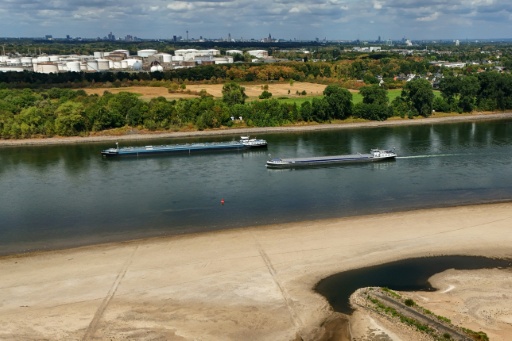
Parts of the Rhine river in Germany could soon become unnavigable as water levels drop further due to soaring summer temperatures and low rainfall, an industry group warned Monday.
Levels have been at record lows since the end of July as Germany, like elsewhere in Europe, struggles through a series of heatwaves.
Cargo ships have managed to continue transporting goods along the waterway, which flows through the industrial heartland of Europe's top economy, albeit with reduced loads and at higher costs.
But the BDB association of inland shipping warned the water level at the town of Kaub -- used as a reference point for vessels plying the waterway -- is expected to fall even further this week.
"With water levels this low, commercial shipping will no longer be able to transport goods in the region," the group's managing director Jens Schwanen told the Rheinische Post newspaper.
"In principle, this means the Rhine is no longer continuously navigable and thus divided in two."
There would still be shipping on the river in the Netherlands and in Germany up to around Cologne, and further south on several tributaries, he said.
But water levels along much of the Rhine in Germany would be too low for vessels to pass.
A spokeswoman for the WSV agency responsible for managing German waterways told AFP that "water levels are expected to continue to fall slightly over the coming days".
There are no bans on shipping, however, she added, and it was up to the individual captains to decide how to adjust their cargoes to adapt to the lower waters.
Asked about the BDB's warning, a transport ministry spokesman said that the government was "monitoring very closely whether the situation will turn out as described in that scenario".
The Rhine originates in the Swiss Alps, flows through and along the borders of several countries, and empties into the North Sea in the Netherlands.
Problems on the Rhine have already prompted some German companies, including steelmaker Thyssenkrupp and chemical giant BASF, to use shallow-draft ships to continue transporting raw materials and finished products.
A halt to shipping on parts of the key economic artery would deal yet another blow to Germany's economy, already battling problems ranging from the Iran war energy surge and US tariffs.
Chancellor Friedrich Merz's government is weighing help for companies who transport goods via the river, including the chemical and oil sectors, and has agreed with some states to temporarily lift a ban on trucks driving on Sundays and public holidays.
Latest stories
Economie/Finances Allemagne : le nouveau ministre des Transports confronté aux déboires de la Deutsche Bahn
Deux semaines après sa prise de fonctions, le ministre allemand des Transports Steffen Bilger a été confronté lundi aux difficultés chroniques de la Deutsche Bahn, après avoir dû changer de wagon à la suite d'une panne de climatisation...

Vidéos Monde Sécheresse : dans les villes, des airs d'automne bien avant l'heure
Feuilles mortes, pelouses grillées et plantes qui souffrent: les villes ont pris cet été des airs d'automne bien avant l'heure en raison des...

Vidéos Monde Les canicules à répétition s'invitent dans la recherche de logements
Avec trois vagues de chaleur en un été, les Français commencent à intégrer les fortes températures dans leurs critères de recherche de nouveau logement, en scrutant la présence de volets...