


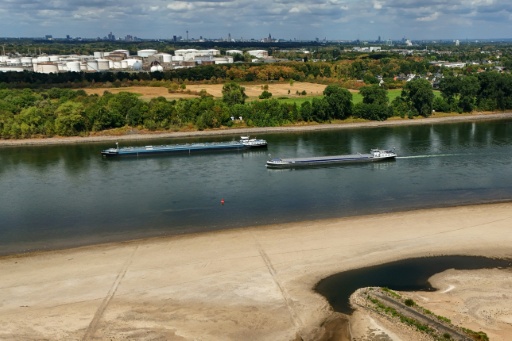
Parts of the Rhine river in Germany could soon become unnavigable as water levels drop further due to soaring summer temperatures and low rainfall, an industry group warned Monday.
Levels have been at record lows since the end of July as Germany, like elsewhere in Europe, struggles through a series of heatwaves.
Cargo ships have managed to continue transporting goods along the waterway, which flows through the industrial heartland of Europe's top economy, albeit with reduced loads and at higher costs.
But the BDB association of inland shipping warned the water level at the town of Kaub -- used as a reference point for vessels plying the waterway -- is expected to fall even further this week.
"With water levels this low, commercial shipping will no longer be able to transport goods in the region," the group's managing director Jens Schwanen told the Rheinische Post newspaper.
"In principle, this means the Rhine is no longer continuously navigable and thus divided in two."
There would still be shipping on the river in the Netherlands and in Germany up to around Cologne, and further south on several tributaries, he said.
But water levels along much of the Rhine in Germany would be too low for vessels to pass.
A spokeswoman for the WSV agency responsible for managing German waterways told AFP that "water levels are expected to continue to fall slightly over the coming days".
There are no bans on shipping, however, she added, and it was up to the individual captains to decide how to adjust their cargoes to adapt to the lower waters.
Asked about the BDB's warning, a transport ministry spokesman said that the government was "monitoring very closely whether the situation will turn out as described in that scenario".
The Rhine originates in the Swiss Alps, flows through and along the borders of several countries, and empties into the North Sea in the Netherlands.
Problems on the Rhine have already prompted some German companies, including steelmaker Thyssenkrupp and chemical giant BASF, to use shallow-draft ships to continue transporting raw materials and finished products.
A halt to shipping on parts of the key economic artery would deal yet another blow to Germany's economy, already battling problems ranging from the Iran war energy surge and US tariffs.
Chancellor Friedrich Merz's government is weighing help for companies who transport goods via the river, including the chemical and oil sectors, and has agreed with some states to temporarily lift a ban on trucks driving on Sundays and public holidays.
Latest stories

Politik Finanzministerium verteidigt Pläne für Steuerreform gegen Kritik
Das Bundesfinanzministerium hat die Pläne von Ressortchef Lars Klingbeil (SPD) für die Reform der Einkommensteuer gegen Kritik verteidigt. Eine Sprecherin betonte am Montag in Berlin, "dass wir genau das umsetzen, was im Koalitionsausschuss auch beschlossen wurde". Dabei gehe es "darum, kleine und mittlere Einkommen zu entlasten" und...

Sports "Lust am Fußball verloren": Karius erinnert sich an dunkle Zeit
Fußballerisch hätte es für Torhüter Loris Karius mit dem Aufstieg von Schalke 04 in der vergangenen Saison kaum besser laufen können - dabei hatte er einige Jahre zuvor fast die Leidenschaft am Sport verloren. Kurz vor seiner Bundesliga-Rückkehr erinnert sich der 33-Jährige an eine schwierige Zeit: "Ich hatte Probleme und auch ein bisschen die Lust am Fußball verloren. Ich habe mich...

Sports Medien: Kane vor Vertragsverlängerung
Harry Kane steht angeblich vor einer Vertragsverlängerung beim FC Bayern. Wie die englische Times berichtet, sollen in dieser Woche Gespräche zwischen dem 33 Jahre alten Torjäger und den Münchner über eine Zusammenarbeit bis 2029 beginnen, die Verhandlungen sollen nur noch Formsache sein. Der bisherige Vertrag von Kane, der vor drei Jahren für eine Ablösesumme von 100...