


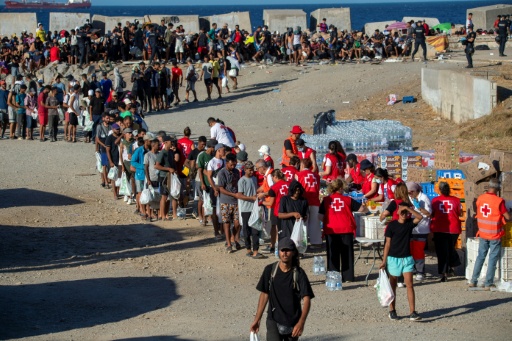
Spain's government took steps on Tuesday to speed up the return of thousands of migrants still in the Spanish territory of Ceuta following a mass influx from Morocco in July.
More than 70,000 migrants entered the small enclave in North Africa in late July, swimming or crossing on foot from neighbouring Morocco in a chaotic influx that left scores dead and fuelled fresh tensions in the European Union over migration.
Most have since returned to Morocco, but between five percent and 10 percent of those who entered -- between 3,500 and 7,000 people -- remain in Ceuta, including unaccompanied children who cannot simply be deported.
Local residents have complained about insecurity and hygiene problems linked to homeless migrants sleeping or roaming in the streets, accusing the left-wing central government of neglecting Ceuta.
Spanish authorities must identify those remaining in Ceuta to establish whether they are entitled to international protection or, if not, begin procedures for their return.
The process has been criticised as too slow by Ceuta's regional government, which is controlled by the conservative Popular Party (PP).
To speed up the response, Spain's cabinet on Tuesday approved the creation of a "single command" for Ceuta, to be led by Territorial Policy Minister Angel Víctor Torres.
The priority is "the return and repatriation of the greatest possible number of people, adults and minors", while respecting Spanish law and human rights, Torres told reporters after the cabinet approved the measure.
While return procedures are accelerated, the government will continue to provide humanitarian assistance to those who seek asylum or are unaccompanied minors and therefore cannot be returned, he added.
The government announced last week that reception centres would be created for 1,800 migrants.
More temporary accommodation will be made available "in order to restore normality in Ceuta", government spokeswoman Elma Saiz said.
Ceuta, together with Spain's other North African enclave of Melilla, has the European Union's only land borders with Africa.
The territories have a special arrangement within the free-travel Schengen zone, meaning people cannot travel onwards to mainland Spain without border checks.
The fate of the migrants has become a major political flashpoint, with Spain's government facing demands from the conservative opposition and far-right parties for all those who entered, including minors, to be returned to Morocco.
But Torres said Spain had to abide by international law, warning that those advocating such a solution "out of populism or to scrape together a few votes are mistaken".
Latest stories

Economie/Finances Les Bourses européennes terminent sans direction claire: Paris -0,16%, Londres +0,29%, Francfort +0,61%
Les Bourses européennes ont terminé la séance mardi sans direction claire, brassant toujours de faibles volumes d'échanges dans l'attente des résultats de Nvidia, baromètre de la tech, et de la réunion des...

France Education : Attal veut un ministre pour 5 ans et rétablir le certificat d'études
Gabriel Attal propose une loi de programmation pour l'école, pilotée par un ministre "qui restera en poste cinq ans", avec notamment le rétablissement du certificat d'études à l'entrée d'un collège "plus individualisé"...

France Cyberattaque: Édouard Geffray assure que la rentrée scolaire pourra se tenir normalement
Les perturbations liées à la cyberattaque visant l'Éducation nationale cet été "n'empêchent pas la rentrée" scolaire, a assuré mardi le ministre Édouard Geffray, précisant que la plupart des accès aux services...