


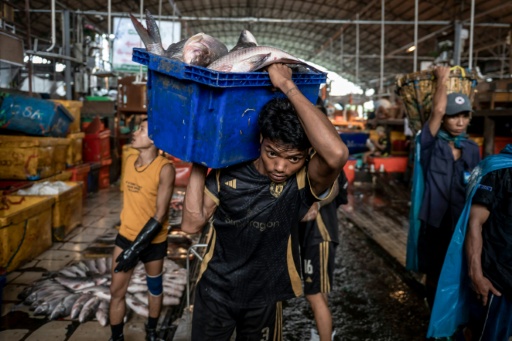
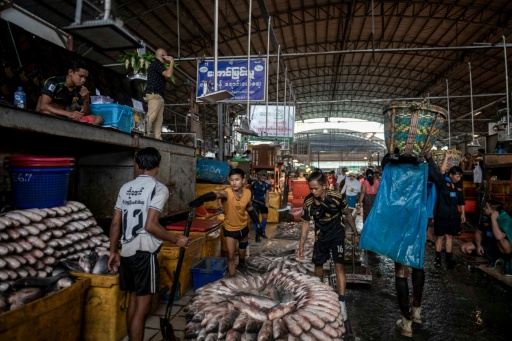
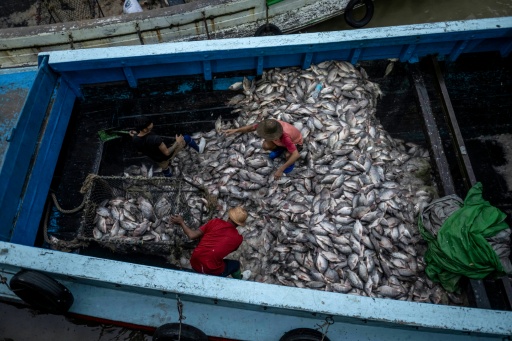
At dawn, the fish markets of Yangon are a chaotic hive of activity as workers sort through vast piles of fresh supplies heaped along the banks of the Hlaing river.
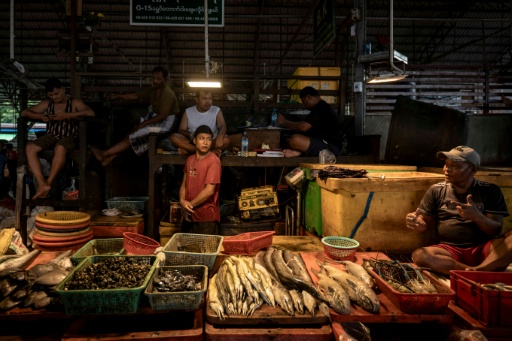
Clad in protective rubber gloves and boots, they wade through melted ice to unload fish and seafood at Shwe Padauk Fish Market, home to almost 500 vendors.
The facility and the older San Pya Fish Market are integral links in the Yangon food chain, transit points for protein that feeds millions of people across the city.
About 400,000 viss -- a traditional unit of weight in Myanmar -- equivalent to more than 650,000 kilograms (1.43 million pounds) of freshwater products pass through Shwe Padauk market daily, the government said in May, and it also handles marine goods.
But like everywhere in Myanmar, the markets cannot escape the country's five-year-old civil war.
The work is physically gruelling, and vast numbers of young men have left Myanmar in recent years to seek work abroad and avoid the conscription introduced to bolster the military, which ousted Aung San Suu Kyi's elected government in 2021.
Fighting in the western state of Rakhine, formerly a huge supplier of seafood, has also hit business, according to workers.
"For about five months, business hasn't been good," one supervisor said.
"Many of the workers have gone to Malaysia to work abroad."
Saltwater supplies now come mainly from the Irrawaddy Delta, southwest of Yangon, they said.
And the Iran war increased the cost of fuel across the world, driving up the price of fish and impacting demand.
"My income has dropped this year. It is not like the past few years," said a 40-year-old seafood dealer from Shwe Padauk Fish Market, speaking anonymously for security reasons.
"Commodity prices have gone up and sales have also dropped among the vendors," he told AFP.
"Because the prices are so high, it must be that people cannot afford to buy and eat much fish anymore."
Workers said they earned between 15,000 to 25,000 kyats ($7 to $12) a day -- more than garment factory workers, who unions say are paid 10,000 to 20,000.
The dealer said he had many friends at the market.
"Outside, we're like brothers," he told AFP.
"But inside the market, business is business. When fish is scarce, we have to fight each other for it.
"Once we head home, though, we're back to being brothers again."
Latest stories
La Une Après deux semaines d'hostilités, Trump n'en a "pas fini du tout" avec l'Iran
Les Etats-Unis n'en ont "pas fini du tout" avec l'Iran, a averti mardi Donald Trump, deux semaines après la reprise des hostilités qui menacent de s'étendre à la mer Rouge...
Monde Guerre au Moyen-Orient: les derniers développements
Voici les derniers développements liés à la guerre au Moyen-Orient, où les hostilités ont repris le 7 juillet entre l'Iran...

La Une Une moisson de textes adoptés définitivement au Parlement pour clore la session
Une fin de session fructueuse pour le gouvernement, mais aussi plus tendue que jamais: le Parlement a approuvé définitivement six textes mardi, dont plusieurs projets de lois emblématiques, dans une atmosphère surchauffée à l'Assemblée...