


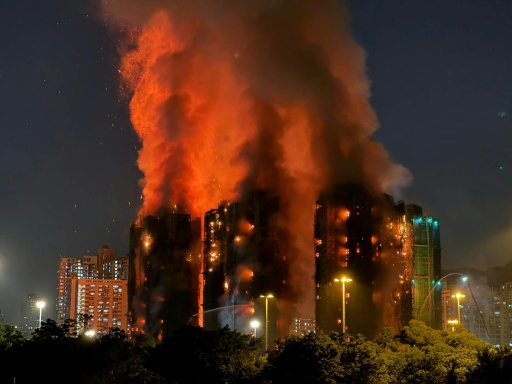
A devastating fire that ripped through a Hong Kong apartment complex last year and killed 168 people was "preventable", lawyers told a committee investigating the blaze in closing statements on Friday.
The November 26 fire at Wang Fuk Court was the world's deadliest residential building blaze since 1980.
It engulfed seven of the eight high-rise blocks, which were covered in bamboo scaffolding, protective netting and foam boards for renovations.
Almost all fire safety measures failed that day because of human errors, the judge-led panel heard over five sessions since March.
The disaster "was preventable but not prevented, and foreseeable but not foreseen", leading counsel for the committee Victor Dawes told the hearing on Friday.
Former Wang Fuk Court residents attending the hearing wiped away tears as Dawes detailed the rapid spread of the fire.
Evidence suggests the fire was likely caused by a lit cigarette that was improperly disposed of, he said.
The fire alarm and hose systems had been switched off for the renovations, and foam boards placed over the windows, blocking residents' view, the counsel's submissions said.
Building contractors had "knowingly created a massive fire risk" by using non-fire-retardant netting on the facade, Dawes said.
That choice "may have meant the difference between a catastrophic fire that engulfed seven blocks of the estate, and a fire which would have self-extinguished", the counsel's submission said.
Contractors also failed to stop workers smoking or to properly dispose of combustible construction waste, and compromised the main escape route, he added.
The windows of staircases had been removed to let workers easily climb in and out of buildings, allowing smoke and fire to spread more rapidly.
The government "must bear a certain responsibility" for failures in the system, Dawes told the hearing.
"A disaster of this scale should not have occurred and should never occur again," he said.
- 'Pain' -
Government counsel Jenkin Suen acknowledged on Thursday "weaknesses" in the system but said it would be "prejudicial and unfair" to put all the blame on public authorities.
"The primary causes remained the deceit, inaction and deliberate omissions of private actors," the government's closing arguments said.
However, Dawes argued that the government had "created an 'honour system' dependent on 'self-regulation' by contractors, effectively leaving them without oversight".
Residents had noticed problems, but their complaints were passed from one government department to another, and inspections failed to substantiate the claims, lawyers said.
Some residents who had lost loved ones still attended all sessions and "heard about the situation in which their family members lost their lives", Jeffrey Tam, a lawyer representing nine of them, said on Thursday.
"This is a pain that I find hard to imagine."
The complex housed more than 4,600 residents, 1,700 of them over the age of 65. Of those who died, 114 people -- or about 70 percent -- were aged 65 or older.
Authorities have filed charges including manslaughter against seven individuals and two companies over their roles in the fire, and arrested 35 people.
The investigative committee is expected to deliver its report to the government by September.
cla/dhw/ami
© Agence France-Presse
Latest stories

La Une Guerre au Moyen-Orient: nouveaux bombardements, des infrastructures civiles touchées
Les Etats-Unis ont bombardé l'Iran pour la sixième nuit consécutive vendredi et Téhéran les a accusés d'avoir fait des victimes en visant des infrastructures civiles, tandis que plusieurs pays alliés de Washington au Moyen-Orient ont dit avoir été ciblés par des attaques, dont contre une...

Football Mondial-2026: Ecce Olmo, le Picasso de la Roja
L'Espagne est gâtée: elle tient en Dani Olmo un artiste, créateur d'espaces sur le terrain, grâce à sa technique soyeuse et ses passes au bon tempo rappelant les célèbres lignes de Pablo Picasso, qui...
La Une Après l'échec de leur avion commun, Paris et Berlin veulent "une nouvelle dynamique" sur la défense
Friedrich Merz reçoit Emmanuel Macron vendredi près de Cologne pour un dernier conseil franco-allemand du président français, marqué par une obligation d'avancées concrètes...