


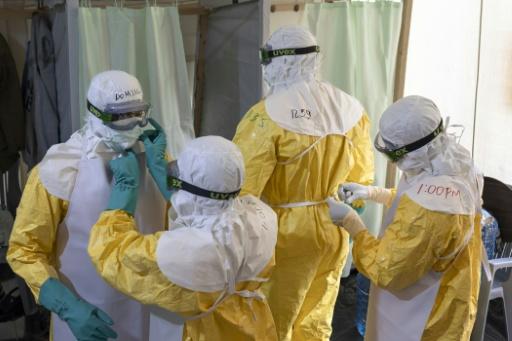
The Ebola epidemic in the Democratic Republic of Congo is still spreading but appears to be showing "encouraging" signs of improvement, the head of the World Health Organization said on Wednesday.
"We are starting to see encouraging signs that we're gaining ground," Tedros Adhanom Ghebreyesus told a news conference in Geneva.
Since the DRC declared its 17th Ebola outbreak in mid-May, more than 3,500 deaths have been recorded from over 7,200 cases to date across seven northern and eastern provinces plagued by widespread insecurity and a litany of armed groups.
Ebola, which is transmitted through contact with bodily fluids and can cause severe internal and external bleeding and organ failure, has killed more than 15,000 people in Africa over the last 50 years.
Tedros said that transmission was declining in the worst-affected areas of Ituri province, the epicentre of the outbreak, while South Kivu has not reported any new cases since May.
"Trials of treatments and post-exposure prophylaxis are picking up speed, due to increased community engagement," he added.
"Vaccine trials should begin in the coming weeks," Tedros said, while warning against complacency. "Make no mistake: the epidemic continues to grow and continues to kill," he said.
"We still have many, many months ahead of us," added Maria Van Kerkhove, director of epidemic and pandemic management at the UN health agency.
In North Kivu, the number of cases was rising "fast", Tedros said, with weekly cases almost doubling from about 100 to more than 200.
"The area is so vast that it is hard to speak of a single epidemic. It is many outbreaks, in many places. We must get the response right in every one of them," he added.
The remoteness of the province, high population mobility and attacks on humanitarian workers were further complicating efforts to fight the epidemic, he explained.
The Africa Centres for Disease Control and Prevention (CDC) and the WHO issued a funding appeal in June for $518 million to support the epidemic response until November.
Both organisations and the Congolese government earlier this month launched a new bid for $1.3 billion for the next six months, on top of the $1.1 billion requested by the UN in August for humanitarian assistance, WHO health emergencies chief Chikwe Ihekweazu said.
There is currently no approved vaccine or treatment against the Bundibugyo strain responsible for the current outbreak.
Some 70,000 doses of the Ervebo vaccine, which has been approved against the Zaire strain of Ebola, have been sent to the DRC to assess its effects on tackling the spread of Bundibugyo.
More than 3,000 health workers and frontline staff have already been vaccinated in Kisangani, said Meg Doherty, director of science for health at the UN health agency.
An observational study led by the Doctors Without Borders (MSF) charity will start on Saturday to evaluate the vaccine's effectiveness in reducing illness and death, she added.
Clinical trials of two vaccines in development against Bundibugyo will take place in the country on a date to be fixed.
Latest stories
La Une Pour tenter de contenir la colère sociale, Lecornu prolonge les aides sur les carburants
Face aux inquiétudes grandissantes de l'opinion sur le pouvoir d'achat, Sébastien Lecornu a demandé mercredi à ses ministres de "prolonger" jusqu'au 31 décembre les...

La Une Depuis le Liban, Carlos Ghosn échoue à faire dérailler son procès pour corruption avec Rachida Dati
Absent de son procès pour corruption et trafic d'influence, l'ex-PDG de Renault Carlos Ghosn a échoué à faire reporter l'audience où il est jugé depuis mercredi à Paris avec Rachida Dati pour les 900.000 euros versés par...

Vidéos Monde 30 ans de Pokémon: à Nantes, des fans se ruent sur les produits collector
Une longue file d'attente s'est formée, mercredi à Nantes, devant une boutique dédiée aux cartes à collectionner, alors que des fans de Pokémon se sont rués sur les produits édités...