


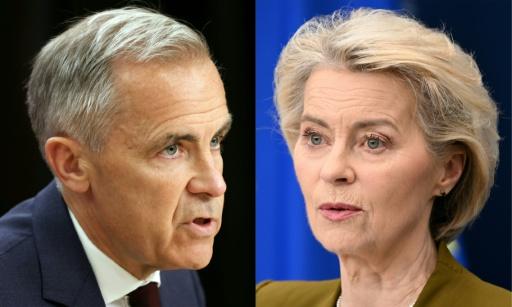
From investments in AI to energy supplies, a drive to strengthen EU-Canada ties shifts into gear Wednesday, as the bloc's chief lays out the coming year's priorities before European lawmakers -- and Canadian leader Mark Carney.
European Commission president Ursula von der Leyen will call for boosting relations with Ottawa in a wide-ranging speech before the European Parliament in Strasbourg that Carney is attending as guest of honour -- before addressing the assembly himself the next day.
The Canadian prime minister has been pursuing a "unique alliance" with the 27-nation bloc as both seek to reduce dependence on a hostile United States.
The first foreign head of government to attend the annual "State of the European Union" address, his visit is meant to act as a catalyst ahead of an EU-Canada summit in Montreal next month.
"The world has been a bit tumultuous in the past little while," Canada's ambassador to the EU Jonathan Wilkinson told AFP. "It's an important time for us to reach across and to try to figure out how we can mutually help each other."
Buffeted by US tariffs and competition from China, Brussels and Ottawa are seeking to build on an already considerable level of cooperation.
The European Commission declined to comment on the detail of discussions but a spokesman said the level of ambition was high and that von der Leyen would have something "positive and meaningful" to say on Wednesday.
A free-trade agreement (CETA) that abolished almost all tariffs has been credited with boosting trade in goods and services by more than 80 percent since 2016.
And this year Canada became the first non-EU country to join the bloc's defence procurement programme.
Yet there is room for improvement, observers say.
Wilkinson said the two parties were looking at areas "where we have complementary capabilities and needs" and that are "strategically important" to "ensure our sovereignty", such as energy, artificial intelligence and critical minerals.
Ottawa was hoping to get over the line a deal allowing the European Investment Bank (EIB) to put money behind Canadian critical minerals projects -- something that could help reduce dependency on China for raw materials essential for electronic goods such as batteries, he said.
He cited a recent deal to ship Canadian liquefied natural gas (LNG) to Germany and Canadian AI firm Cohere's investments in the same European country as examples of deals that could inspire broader collaboration.
"It's about actually accelerating that work," Wilkinson said in a phone interview.
There are also some low-hanging fruit.
Ten EU nations including France, Italy and Poland, are yet to ratify CETA in part due to opposition from local farmers, which has limited its impact.
Provisions on investment protection and dispute resolution remain a dead letter as it stands.
"This continued delay weakens the EU's credibility as a reliable trading partner," the European Parliament's centrist Renew group wrote in a letter to EU trade commissioner Maros Sefcovic, urging Brussels to push for full ratification.
Some EU lawmakers have also called for initiatives to promote CETA among small and medium businesses that are not yet taking full advantage of its benefits.
Talks are under way in other areas too.
A lot is on the menu, from easing labour mobility rules and increasing student exchanges through the EU's popular Erasmus youth mobility programme, to Canada contributing to the bloc's 90-billion-euro ($105 billion) loan to Ukraine.
"We're actually looking to go beyond simply a free trading relationship, to deepen that relationship across the board," Wilkinson said.
Latest stories

Jornal OpenAI, Anthropic e Google buscam criar órgão de supervisão de riscos da IA
OpenAI, Anthropic e Google DeepMind trabalham na criação de um órgão de supervisão dos riscos relacionados à inteligência artificial (IA), informou a OpenAI à AFP nesta terça-feira (15), em meio a apelos...

Jornal Fluminense perde para Platense (2-1), mas avança à semifinal da Libertadores
O Fluminense se classificou para a semifinal da Copa Libertadores apesar da derrota por 2 a 1 para o Platense nesta terça-feira (15), em Buenos Aires, depois de ter vencido o jogo de ida na...

Jornal EUA prepara pacote de armas bilionário para Israel (imprensa)
O governo dos Estados Unidos está prestes a aprovar um pacote de armas de US$ 2,8 bilhões para Israel, um dos maiores pacotes de munições vendidos nos últimos anos...