


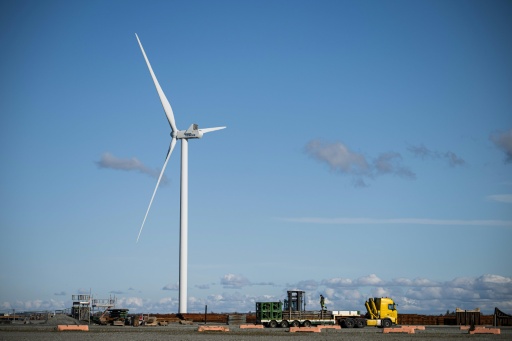
Residents of Moerdijk, a small Dutch port village that survived WWII bombing and subsequent flooding, are facing a new existential challenge: the threat of being bulldozed in the name of clean energy.
Much of the 1,150-strong population has been left asking "why us? why their village?" Pim Meijer, who represents a collective covering around half the residents, told AFP.
The hamlet, dating from the Middle Ages and located in the south of the Netherlands, between the major ports of Rotterdam and Belgium's Antwerp, has been earmarked by the government for possible eradication.
The reason? To make way for a facility that would receive electricity from offshore wind farms to power the country’s ports -- among Europe's busiest -- in a more sustainable way.
Residents, who have taken to hanging up protest banners on their homes declaring "Moerdijk must stay", are feeling "anger, incredulity -- and mistrust towards the government," Meijer said.
"There are people who were born and who have grown up here -- some today are in their 90s," he said. Some families "have lived in Moerdijk for three or four generations... You can't just leave all that behind you."
Yet for energy engineers, the little village is "perfect" for the planned facility, explained Patrick Witte, associate professor for land planning.
"The village is situated just between the ports of Rotterdam and Antwerp, with its transport links via sea, motorway and rail facilitating the grouping together of energy, port-related and infrastructure installations," he said.
The authorities' project, called Powerport, involves developing several hundred hectares for large-scale energy infrastructure, green industry and recycling in the chemicals sector.
"This development is necessary to connect offshore wind power and alleviate grid congestion", states the Moerdijk Port website.
The local council, after enduring years of political delay at the national level, had resigned itself to seeing the village disappear. It was waiting for the next stage to be announced: financial compensation for the soon-to-be dislodged residents.
But then, a couple of months ago, the Netherlands' new government suddenly suggested a change -- the project, it said, could potentially go ahead on a smaller site than originally planned, on the outskirts of the village, allowing Moerdijk to be saved.
A final decision is yet to be made.
The government is still considering the issue and has not set a deadline.
Meanwhile, uncertainty weighs heavily on Moerdijk's inhabitants, their lives in limbo.
In the village's streets, the past rubs up against the future.
Amid several abandoned houses, a sign planted in one garden celebrates the birth of a child.
But "some residents are neglecting the upkeep of their homes -- after all, what’s the point? Shopkeepers are no longer investing, and couples with young children are leaving before the school closes down," said Meijer.
The option currently being considered would preserve the village -- but at what cost?
"With energy transition facilities on one side, the port on another and the motorway on a third, residents would find themselves completely surrounded," says Witte, the professor.
The local council wants the national government to make a decision and stick to it.
"If the village is to be preserved, it must remain a pleasant place to live," mayor Aart-Jan Moerkerke, 61, told AFP.
"We also need guarantees that they won’t come knocking on our door again in 15 years’ time with yet another new scheme. Residents have had enough."
Bob Spaans, the 72-year-old former owner of a joinery business, has lived in Moerdijk for 50 years.
His son and grandchildren live there too.
His wife originally hails from the village and loved ones are buried in the local cemetery. He himself has regular chats over a drink with his neighbour.
"We just hope the village can be preserved. But in my opinion, they’ll end up ruining Moerdijk," said the pensioner.
"I have a friend who lives alone. Next door lives a friend. On Fridays, after a beer and still being a bit tipsy, he goes round and says, ‘Jan, fancy a coffee?’.
"That’s what Moerdijk is all about, and we’re going to lose that. You won’t find that anywhere else," he said.
Latest stories
Meio Ambiente Europa Ocidental registrou recorde de calor em junho e julho
A Europa Ocidental "vivenciou o período junho-julho mais quente já registrado", em um cenário de ondas de calor repetidas, seca generalizada e incêndios devastadores, anunciou nesta segunda-feira (10) o serviço...
Jornal Ataques entre Rússia e Ucrânia deixam 18 mortos
Pelo menos 18 pessoas morreram em ataques entre Rússia e Ucrânia, em uma nova escalada dos bombardeios de longo alcance que atingiram tanto a região russa do Tartaristão como...

Jornal João Fonseca perde para atual campeão Ben Shelton, que vai às quartas do Masters 1000 de Montreal
O tenista americano Ben Shelton, 10º colocado do ranking mundial e atual campeão do Masters 1000 de Montreal, eliminou neste domingo (9) o brasileiro João Fonseca (27º) e avançou às...