


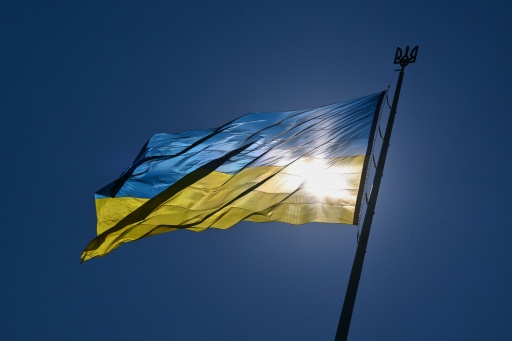
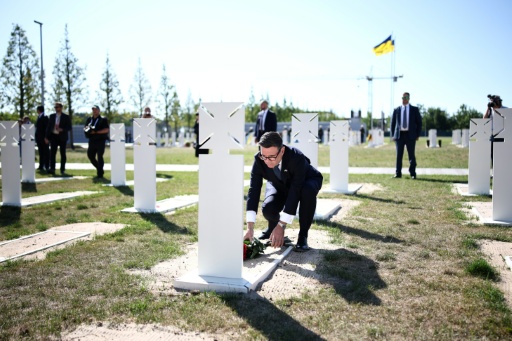
Ukraine's allies on Monday pledged to keep up their support amid Russia's escalating attacks and despite threats from Moscow, as they gathered in Kyiv on Ukraine's Independence Day.
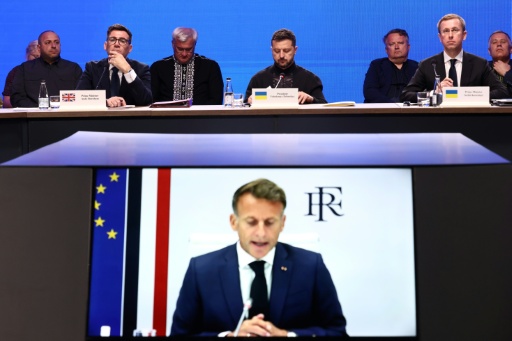
Air defence supplies were the main priority at the meeting of 30 leaders of the so-called Coalition of the Willing, jointly chaired by the leaders of France and Germany, who participated remotely, and by Britain's Prime Minister Andy Burnham.
Burnham arrived in Kyiv for his first trip abroad since taking office, alongside other European leaders and EU Council President Antonio Costa.
"Despite Russia's outrageous threats to my country, we will continue our support for Ukraine's defence," Burnham said.
Russia has recently pounded Kyiv with ballistic missiles, ripping open apartment blocks and killing dozens in the capital.
The escalating Russian strikes have pushed civilian deaths to their highest levels since the first months of Moscow's 2022 invasion.
A Russian drone attack on Chernigiv, north of the capital, wounded 15 people, Ukraine emergency services said, while one person was killed and nine wounded in shelling on Izyum in the east, according to the local authorities.
"Right now, things are really very difficult for all of us. But there is a force holding us firmly by the hand," Ukrainian President Volodymyr Zelensky said in an address, adding: "It is the strength of our mutual circle."
Zelensky later told the assembled leaders in an evening address that he wanted to "raise production" of drones and missiles to wage "more attacks" on Russia, matching its strikes on Ukraine.
For that, "we need more money -- much more," he said.
Burnham told the allies that "the clear message to Putin should be that Ukraine will never give up territory that Russia cannot win on the battlefield, and negotiations must start from the line of contact."
French President Emmanuel Macron warned that "Russia will try to escalate against European countries in order to deter them from assisting Ukraine".
"It's clear that NATO countries will be targeted and the provocations will multiply," he added.
The European Union said Monday it had released another 6.1 billion euros ($7.1 billion) in military aid for Ukraine to boost its air defences.
The finance is part of a 90-billion-euro loan, including 60 billion in military aid, that the EU has said will go to Ukraine.
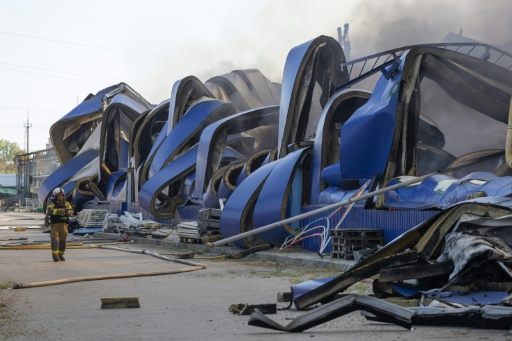
Ahead of the talks, Ukraine has forged ahead with its campaign against Russia's logistics sites, hitting multiple warehouses belonging to e-commerce giant Ozon.
Ozon reported fires early Monday at two warehouses in southern Russia, adding that two other sites had been evacuated over threats of drone attacks.
Russian authorities also said debris from a Ukrainian drone attack had killed three children and wounded eight others.
Russian leader Vladimir Putin on Saturday said Kyiv had "opened Pandora's box" by targeting Russia's economy and promised further escalation, including against Ukrainian agriculture.
Burnham announced in Kyiv that the British government was authorising defence firm MBDA to release classified information needed to help Ukraine and France set up local production of the long-range Storm Shadow/SCALP missile.
The Kremlin accused London of preventing peace in Ukraine by handing the information to Kyiv and threatened to target and "destroy" facilities producing the missile in Ukraine.
On Saturday, Macron pledged Paris would deliver new interceptor missiles.
The ballistic missiles Russia has been firing in their dozens are incredibly fast and travel with a high-arching trajectory, making them difficult for Kyiv to intercept.
Ukraine relies on advanced systems -- chiefly, US Patriot interceptors -- to protect its skies.
But it has reported a shortage of Patriot interceptors since the United States and Israel went to war with Iran in February, diverting supplies.
Ahead of the meeting, Zelensky revealed the extent of the deficit, releasing usually closely guarded numbers.
He said deliveries of crucial Patriot interceptors had halved since 2023.
"Over the entire of 2023, Ukraine received 675 missiles, and over all of 2025 -- 364, even though Russian missile strikes have increased," Zelensky said.
"For 2026, as currently projected, it is 264," he added, saying Ukraine was seeking a package of at least 300 for the upcoming winter.
Latest stories

Latin America New Colombian president announces anti-migrant crackdown
Colombia's right-wing President Abelardo de la Espriella has ordered an immigration crackdown, instructing authorities to begin detaining undocumented foreigners convicted of crimes with...

US News US removes Syria from state sponsor of terrorism list
The United States on Monday removed Syria from its list of state sponsors of terrorism, rescinding a decades-old designation that came with severe economic restrictions and marking another step...
Business and Economy Oil prices fall as Bessent outlines new steps to punish Iran
Oil prices retreated as US Treasury Secretary outlined plans for more sanctions to punish Iran while stock markets mostly faltered on Monday as investors looked ahead to key US...