


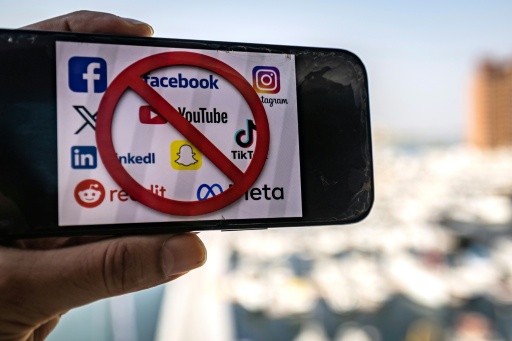
To ban or not to ban children from all social media? That is the big question facing the European Union in its bid to protect minors from harmful content.
To help the EU answer it, an expert panel made up of doctors, academics, youth representatives and parents will deliver their recommendations Monday.
Greece, France and Spain led a push last year for limiting minors' access to social media, with pressure intensifying on the EU executive to establish a bloc-wide ban like Australia did in December.
In response, EU chief Ursula von der Leyen tasked the panel to come up with advice backed by evidence on how the 27-nation bloc should tackle the issue.
She favours limiting children's access to social media and has previously hinted at a ban -- and in May said a legal proposal is expected this summer.
Two European officials told AFP they expect Brussels to unveil a proposal on an age limit, but added no final decisions had been made yet.
The EU would not be drawn on whether von der Leyen would announce a blanket ban.
"We are exploring possibilities to make minors safer online," a spokesperson said. "More can and must be done."
Alongside the recommendations, the EU has ramped up the pressure on social media platforms to change, telling Facebook and Instagram Friday to dismantle their "addictive" features, after a similar warning to TikTok in February.
- Targeting harmful design -
The expert panel met three times in 2026, with the final meeting in June.
Panel members have remained tight-lipped about what they will recommend, but if a German panel is anything to go by, they will not advise a blanket ban.
The German experts, who included the co-chair of the EU panel, put forward two options last month: a statutory minimum age of 13 -- which many platforms have -- or restrictions on individual services and features.
The EU could limit access to social media based on a platform's risks, targeting apps with "harmful designs".
A dilemma for the EU is how to avoid different age limits across 27 countries. For example, Spain wants to ban under-16s accessing social networks, while France proposes prohibiting children aged 15 and under.
And then there are EU nations such as Estonia that oppose a ban.
Digital rights defenders caution against broad-brush measures, and call for a "safety-by-design" approach where the EU demands certain features are removed.
"If features such as infinite scroll or surveillance advertising aren't safe, they shouldn't be on social media in the first place," said Michiel van Hulten, EU director at public policy organisation Reset Tech.
EU consumer protection chief Michael McGrath vowed new rules expected later this year will give children stronger protection against addictive design.
"Digital markets are designed to capture attention and influence behaviour. The new rules will help ensure consumers can make informed choices free from manipulation," McGrath said in a statement to AFP.
raz/del/jhb
© Agence France-Presse
Latest stories
European Edition Ukraine allies to gather in Paris to step up pressure on Russia
Allies of Ukraine will gather in Paris on Monday with the war-torn country's leader Volodymyr Zelensky to reaffirm support for Kyiv and step up pressure on Russia...

US News US hits Iran as Gulf states targeted in flareup over Hormuz
The United States struck Iran Monday for a second day running, drawing Tehran's reprisals against US allies in the Gulf as the foes battle over the status of...

Climate and Environment Huge fire rages in Fontainebleau forest near Paris
French officials rushed two firefighting planes to the Paris region Sunday, after a fire erupted south of the French capital, disrupting traffic during a busy summer travel weekend and piling more misery on...