


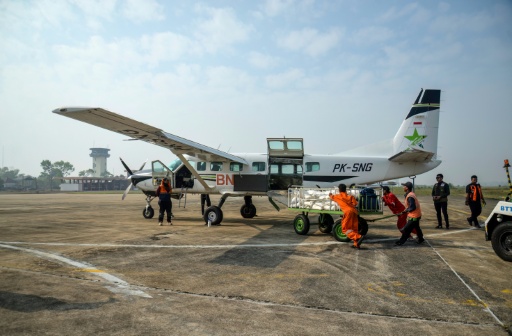
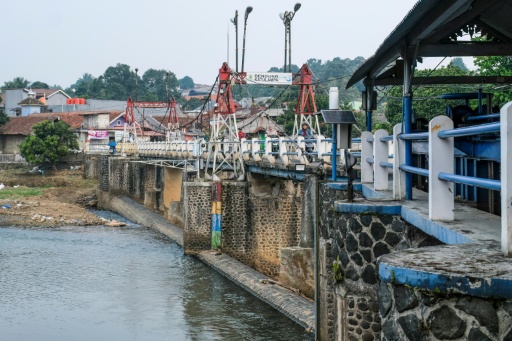
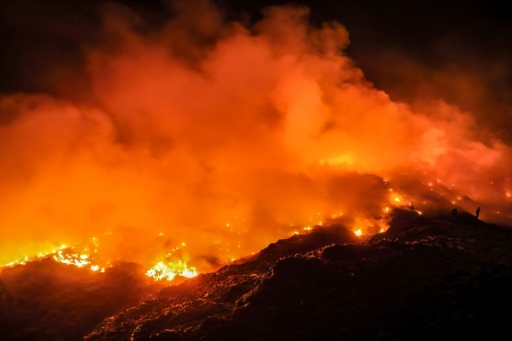
Indonesia's Borneo, home to pristine rainforest and protected species, is burning. Meteorologist Safillah Anggie Wahyuni hopes a solution lies in the clouds.
Indonesia believes cloud seeding can help it tackle a wildfire season that experts say is on track to be among the worst in years, driven by a strong El Nino.
Indonesia's government says over 100,000 hectares burned in the first half of the year.
Independent analysis by deforestation monitoring site Nusantara Atlas puts the figure through July at over 285,000 hectares -- more than four times the size of Jakarta.
Cloud seeding, which involves sprinkling silver iodide, salts or other particles into clouds to trigger precipitation, is rarely used to tackle wildfires globally.
But Indonesia is ramping up efforts, scarred by 2015 fires during a previous strong El Nino that burned through millions of hectares and created a regional haze crisis.
"Weather modification does not create clouds: we optimise clouds that have the potential to produce rains," Safillah told AFP after flying over Palangkaraya in Borneo's Central Kalimantan.
"Weather modification will only be effective if the conditions are right," she added.
Indonesia carried out 252 cloud-seeding operations between 2021 and August this year -- up from 85 in the preceding decade, according to the BMKG weather agency.
Most tried to draw rain away from flooded areas, but many sought to douse wildfires or wet flammable peatlands.
In just three years since her first cloud-seeding operation, 25-year-old Safillah has accumulated more than 300 flight hours.
The technique was first used in Indonesia in 1977 to top up a dam, and the government has said dozens of helicopters and fixed-wing planes are on standby for cloud seeding nationwide.
"We are on alert to changes in weather, even the slightest, which could result in rain clouds," Security Minister Djamari Chaniago said.
But the bulk of the country's firefighting is still done on the ground, with nearly 50,000 firefighters currently deployed.
And experts question the technique's use during the dry season, when wildfires peak.
"Its effectiveness will be very low because of the lack of clouds," said I Putu Santikayasa, a hydroclimatology lecturer at IPB University south of the capital Jakarta.
Research suggests the efficacy of cloud seeding is hard to assess.
It has also raised questions about harms linked to widespread use of silver iodide, as well as the cost.
Cloud seeding is "a mitigation effort, not a permanent solution," acknowledged BMKG weather modification director Budi Harsoyo, insisting there is no evidence of harms.
Research he authored found a 12-day cloud-seeding operation in 2023 doubled likely rainfall and eliminated fire hotspots.
Activists say mitigation efforts like cloud seeding ignore underlying problems, including mass conversion of rainforest and peatland.
Indonesia has large swathes of tropical peatlands.
They are an important carbon store when wet, but become highly flammable when dry and fires can smoulder underground and reignite quickly.
These vulnerable ecosystems should be protected against development, said Uli Arta Siagian, campaign coordinator with local environmental group WALHI.
"The responsibility for protection lies with the state by not issuing permits in areas that are vulnerable to fire," she told AFP.
Indonesia regularly battles devastating fires that send a choking haze over neighbours Malaysia and Singapore.
In recent days, haze from the fires has spiked air pollution levels in the Malaysian part of Borneo island, prompting several school closures.
In addition to cloud seeding, Indonesia is carrying out peatland rewetting and monitoring fire hotspots with satellites and ground patrols.
Large-scale plantations are banned from using fire to clear land, though smallholders are exempt.
But the practice remains common and is blamed for starting most of Indonesia's wildfires.
The environment minister has told local governments in vulnerable regions to beef up preventive patrols and encouraged "legal sanctions" including fines and "criminal penalties" for illegal burning.
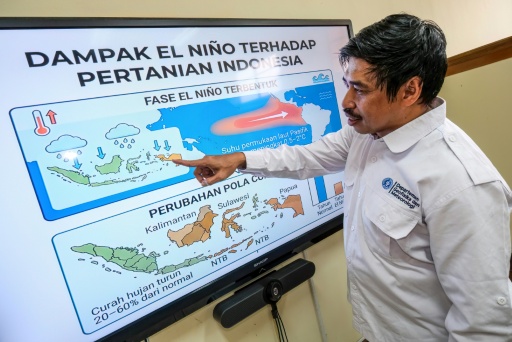
This year's fires will be turbocharged by a powerful El Nino -- a naturally occurring climate phenomenon that brings worldwide changes in winds, air pressure and rainfall patterns.
It typically causes drier conditions in Indonesia and is associated with severe fires.
The area of land burned in just the first half of this year already exceeds the area lost in all of 2023, when El Nino last formed.
Activist group 350.org warned this week that climate change is exacerbating the trend.
El Nino "arrived on top of higher global baseline temperatures, triggering more extreme weather."
Latest stories
Asian Edition Crude extends gains, stocks stagger as Mideast hopes dim
Oil prices extended gains and stocks stuttered Tuesday as a US-Iran deal to reopen the Strait of Hormuz remained distant, a day after the deadline for...
Asia Business Copper powers profit rise at mining giant BHP
Australian mining titan BHP reported Tuesday a solid rise in annual profit boosted by surging prices for copper -- a key metal for the global...
Climate and Environment Whales spark joy in New York but face threats from boat traffic
"WHALE AT ONE...