


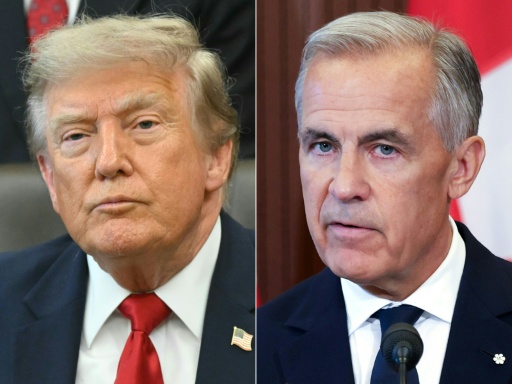
Canada said it will announce Tuesday its response to President Donald Trump's new tariffs, as neighbors that used to be close allies spiral into a trade war.
In response to what it called "these challenging times," the Canadian government said Monday night that the ministers of finance, industry, labor and other officials would hold a press conference in Ottawa to detail Canada's answer to the new levies.
Canada and the United States failed Friday to reach a deal to avert new 50-percent US tariffs on select Canadian goods after weeks of talks. The duties took effect Saturday, and Ottawa laid out plans for retaliation.
Trump added Monday that he would double tariffs on Canadian autos starting next year to 50 percent.
The current US tariff impacting Canadian autos stands at 25 percent for non-US content, while imported steel to the United States generally faces a 50-percent duty. US automakers did not immediately comment on the matter.
After rejecting what he called a "bad deal," Canadian Prime Minister Mark Carney announced retaliatory tariffs effective September 8.
He said these will target US steel and dairy industries, while also covering sectors like agricultural equipment, paper and electronics.
The government statement released late Monday said ministers will "announce new measures to protect and support Canadian workers and businesses during these challenging times."
Carney said Monday that the goal of trade talks with Washington "has always been to get the best deal for Canadians, never a deal at any price or on any time frame."
"We learned that, during the negotiations, the Americans wanted to destroy our major industries -- including the automotive, steel, and aluminum sectors -- through unfair negotiating terms. And that is one of the main reasons why we said no."
He stressed that building domestically and diversifying trade abroad has been "plan A from the start."
Over the weekend Carney added that, at the 11th hour, US negotiators also sought restrictions on Canadian trade deals with other countries.
US negotiators made unacceptable "threats" to the French language and "Quebec culture" too, he said, referring to eastern Canada's French-speaking province.
At a separate event Monday, however, US Vice President JD Vance blamed Canada's "unreasonable last-minute demands."
The United States is by far Canada's biggest trading partner, with Canadian exports to its neighbor representing 70 percent of its overall total.
Canada is the United States' second biggest trading partner in goods this year, behind Mexico, government data showed.
Three in four Canadians support the Carney government's decision to walk away from trade talks, according to polling released Sunday by the Angus Reid Institute.
However, the research group noted that two in five Canadians have some fear about their jobs.
Ontario Premier Doug Ford criticized Trump's tariff threat on autos, saying he could "kiss my ass."
Ford warned that an electricity surcharge was on the table. In an earlier phase of the dispute, Ontario imposed a 25-percent surcharge on electricity exports to three US states.
Trump lashed out at Ford online, warning of "far worse" consequences.
The White House had alleged "discriminatory treatment" by Canada against US alcohol, automobile and dairy products in rolling out the 50-percent tariffs.
Trump delayed their implementation by three days last week, but both sides failed to reach an agreement after talks went down to the wire.
The latest duties hit about 5.5 percent of Canadian goods entering the US, worth some $20 billion, impacting products like hockey sticks and cement.
Trump charged Monday that "Canada has been ripping off the United States of America for years," adding "we don't need Canada, they need us."
US Trade Representative Jamieson Greer told The New York Times on Saturday that the Trump administration offered to eliminate a 10-percent tariff on softwood lumber, and reduce the 25-percent autos tariff.
Washington was also ready to cut steel tariffs from 50 percent to 25 percent for most Canadian steel, said Greer.
Besides the tariffs fight, Washington and Ottawa have to agree on revisions to the US-Mexico-Canada free trade agreement (USMCA) which Trump has declined to renew in its current form.
Trump has also repeatedly antagonized Canadians with his threats to make Canada a US state and calling Carney and his predecessor Justin Trudeau "governor" -- as if they were US politicians, not prime ministers of an other country.
Latest stories

Society Families of detained Chinese Christians cling to faith in legal limbo
Clasping her hands together in prayer, four-year-old Huanle tells God she misses her mum, whom she hasn't seen since Chinese authorities raided their home last year in...
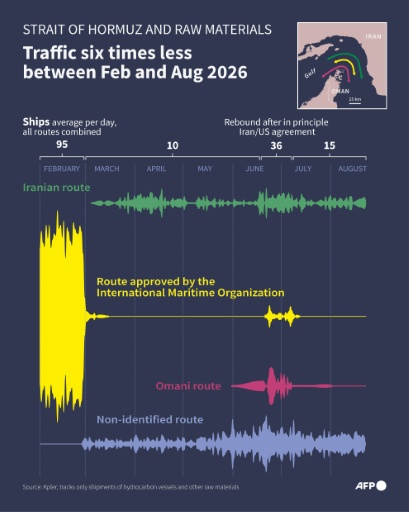
Business and Economy Six months into Iran war, Hormuz traffic way down, sailors stranded
Six months since the start of the Middle East war, the strategic Strait of Hormuz remains largely paralysed, with thousands of sailors still stranded in the Gulf and commodity carrier...
Asian Edition Stocks stagger and oil rises as traders eye Iran threat, Nvidia results
Asian stocks fluctuated Tuesday while oil edged up as investors assess a US plan for the "economic asphyxiation" of Iran, while tech firms struggled following another down day on Wall Street and...