


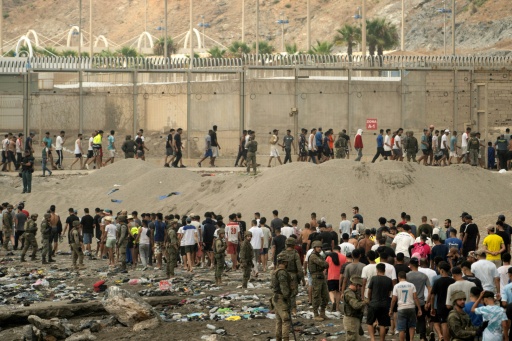
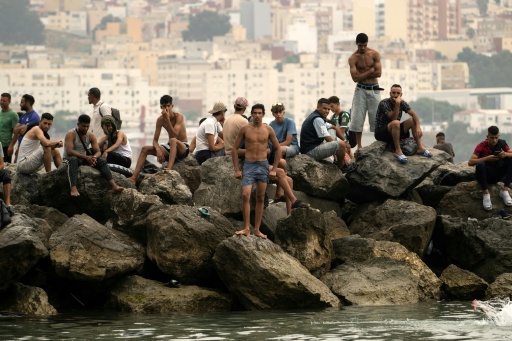
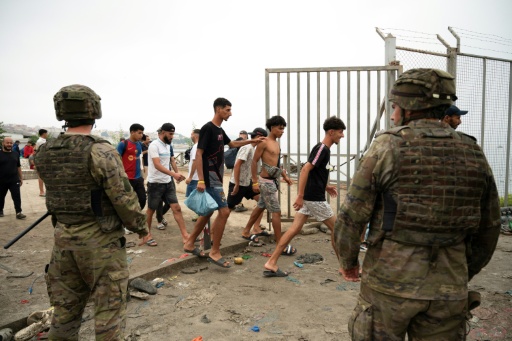
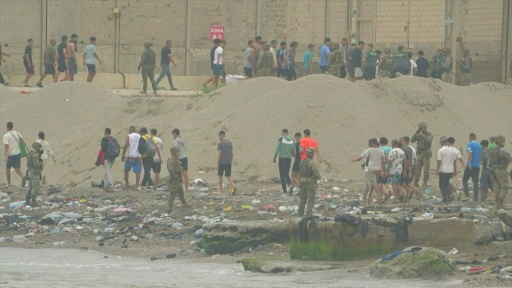
Shops remained closed, bread was in short supply and Ceuta's annual fiestas have been cancelled as Spain's North African enclave struggled to cope after thousands of migrants poured in from neighbouring Morocco.
Shuttered storefronts lined Calle Real, the city's main commercial artery, where the usual flow of shoppers and residents had been replaced by scores of migrants milling around the streets.
In the centre of Ceuta, home to around 84,000 people, most businesses were closed, with only pharmacies and a branch of the Spanish casual dining chain VIPS remaining open.
"We are running short of bread. There was no fresh bread today because the bakeries are closed," Miguel Angel Campana, a municipal street cleaner in Ceuta, told AFP.
He said residents feared migrants would force their way into homes "asking for water and other things" and he urged people to "watch your balconies".
Some migrants were stopping cars in the road to ask for food, money or to use mobile phones to call their families, AFP reporters said.
The Confederation of Businesses of Ceuta has advised shops and other commercial establishments to remain closed "until security can be guaranteed".
Some 60,000 migrants crossed into the territory from Morocco, local officials said. Many swam around a small border barrier that juts out into the Mediterranean Sea.
AFP reporters saw hundreds of people -- men, women and children -- entering Ceuta, discarding flotation rings and clothes used in their crossing.
The influx is one of the largest migrant arrivals ever recorded in Ceuta, sparking an international crisis for Madrid and drawing criticism from Germany, Italy and Finland.
Spain has sent troops to manage security, and says more than 37,500 migrants who had crossed have returned to Morocco.
Police in the centre of Ceuta directed migrants -- many of them youths -- towards the border, sometimes threatening them with batons.
Mohammed, a local taxi driver and Ceuta resident, said he believed that many of the migrants were deciding to return to Morocco because they expected better conditions in the enclave.
"They thought they already knew what they were going to find here, and they have come up against reality," he told AFP, saying some migrants told him they were returning "because they had no food".
"There is nothing here. Those of us who are from here are struggling to make a living. We're struggling," he said.
Mohammed said he and his neighbours had stayed up until the early hours of the morning to protect against possible thefts by the migrants.
"I have nieces who are scared," he added.
Yolanda Moreno, 56, said she had felt "fear from the very beginning" of the migrant crisis.
"It was like during the pandemic -- the feeling that it was better to stay at home than go outside," she said.
Ceuta's regional government cancelled the city's annual patron saint festivities, which were due to begin on Saturday, due to the "current circumstances".
At the fair ground, bumper cars and other rides remained covered in their protective plastic sheets.
Latest stories
Mundo Grecia desaloja parte de un suburbio de Atenas por los incendios
Los bomberos combaten el viernes varios incendios en Grecia, donde los vientos fuertes obligaron a las autoridades a ordenar la evacuación de parte...
Montevideo Con Messi en duda, la MLS se relame con el duelo entre Son y Müller
Lionel Messi está de regreso a la disciplina del Inter Miami, pero está en duda su presencia en la jornada del fin de semana de la MLS, atravesada por el cara a...
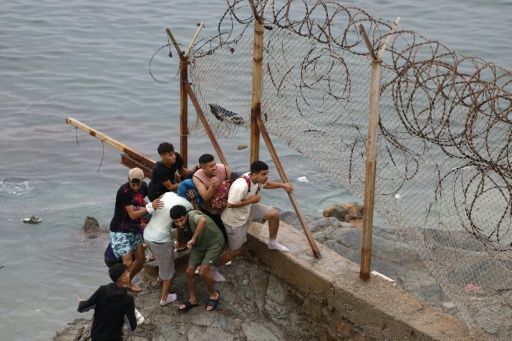
Mundo La entrada de 60.000 migrantes en el enclave español de Ceuta desata una crisis europea
La llegada por tierra y por mar de cerca de 60.000 personas procedentes de Marruecos al enclave español de Ceuta, que España calificó de "ataque" a su integridad territorial, provocó este viernes una crisis...