


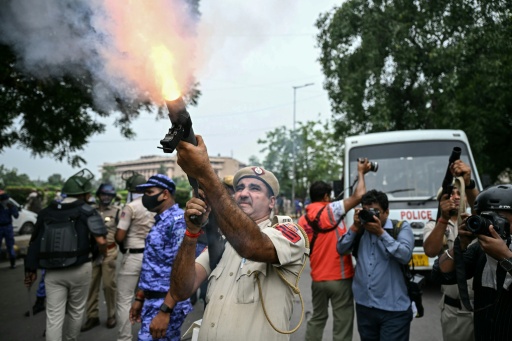
Indian police used excessive force, including electric shock devices and pellet guns, against youth-led protests that forced the education minister to resign last month, Amnesty International said Monday.
A report from the rights' group clashes with the police account that force was used only after protesters turned violent, and comes after India's Supreme Court set up a panel on Thursday to investigate violence by both police and demonstrators.
Demonstrations in the capital New Delhi, triggered by the leak of the national medical entrance test, turned violent on July 20 when thousands of protesters attempted to march towards parliament.
Amnesty said witness testimony and visual evidence it had verified confirmed the use of "pellet-firing shotguns, tear gas launchers, grenades, batons and electric shock devices against protesters" in Delhi and the eastern state of Bihar.
Amnesty said it had also verified two instances of a police officer "unlawfully using lethal force against a crowd" in Bihar's Siwan district. No one was killed.
"The weapons were deployed in a manner that breached international law and standards and domestic policing guidelines," it added.
Amnesty said that there were "isolated incidents of protesters throwing stones", but that the "heavy-handed response was state-sanctioned violence masked as crowd control."
Delhi Police said in a Supreme Court hearing last week they had used force only after protesters "resorted to violence".
They said anti-social elements "masquerading as aggrieved students" caused "grievous injuries" to security forces.
On Friday, opposition leader Rahul Gandhi staged a sit-in outside a Delhi police station with a 19-year-old protester who said he was injured by pellets during the July 20 demonstration.
Gandhi demanded a police investigation into the shooting, and officers later registered a case over the complaint.
Led by the online Cockroach Janta Party, the protests broadened from anger over exam irregularities into a wider movement over unemployment, opportunities for young people and what critics describe as Prime Minister Narendra Modi's increasingly authoritarian rule.
The protests proved to be the biggest challenge that Modi has faced after winning a third term in 2024.
Latest stories
Topthemen AOK-Bundesverband fordert mehr Prävention - Kritik an niedrigen Preisen für Tabak und Alkohol
Der AOK-Bundesverband fordert in der Debatte um die Zukunft der gesetzlichen Krankenversicherung mehr vorbeugende Gesundheitsmaßnahmen und sieht vor allem bei Tabak und Alkohol Handlungsbedarf. "Wir müssen bei der Prävention besser werden. Wir tun in Deutschland zu wenig dafür, dass Menschen gar nicht erst krank werden", sagte die Vorsitzende des...
Topthemen Neuer britischer Premier Burnham unternimmt erste Auslandsreise am Montag nach Kiew
Der neue britische Premierminister Andy Burnham wird seine erste Auslandsreise seit Amtsantritt am Montag in die Ukraine unternehmen. Nach Angaben seines Büros will der Labour-Politiker dabei bekannt geben, dass seine Regierung zugestimmt habe, dass der europäische Rüstungskonzern MBDA geheime Informationen zu britischen Komponenten der Storm-Shadow-Marschflugkörper weitergeben darf. Die der Ukraine gelieferten Marschflugkörper werden in Frankreich Scalp genannt. Diese Entscheidung "wird es den Franzosen und den...

Sports Adeyemi trifft: Barcelona siegt zum Auftakt deutlich
Nationalspieler Karim Adeyemi hat beim FC Barcelona einen Einstand nach Maß gegeben und mit seinem neuen Klub einen deutlichen Auftaktsieg gefeiert. Die Mannschaft von Trainer Hansi Flick gewann ihr erstes Saisonspiel in Spaniens La Liga mit 5:0 (2:0) beim FC Elche, Adeyemi gelang gleich in seinem ersten Pflichtspiel für den Meister der erste Treffer. Im Sommer war er...