


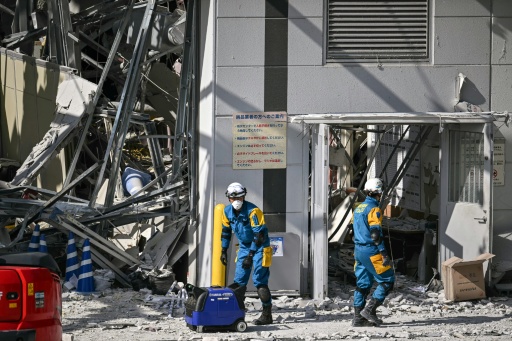
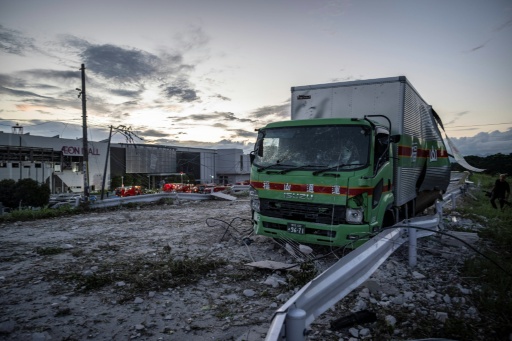
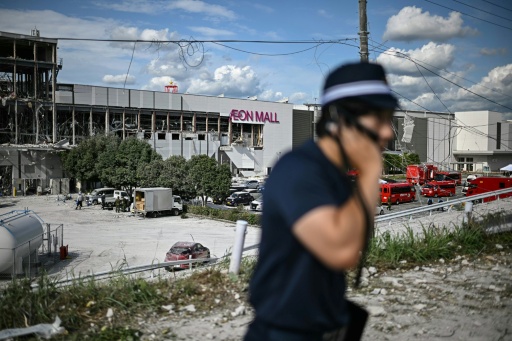
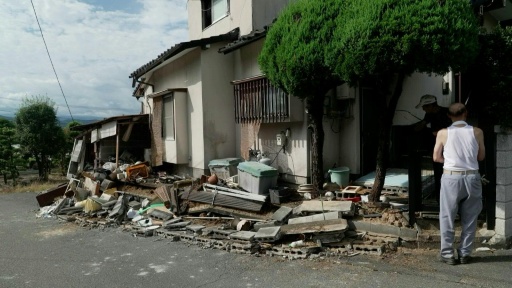
Rescuers battled through the tangled wreckage of a Japanese shopping mall Wednesday searching for any trapped survivors after a big earthquake killed at least 13 people.
A massive explosion ripped through the mall around 50 minutes after the 7.1-magnitude tremor on Tuesday in the southwestern Kumamoto region, where in 2016 twin quakes killed nearly 300 people.
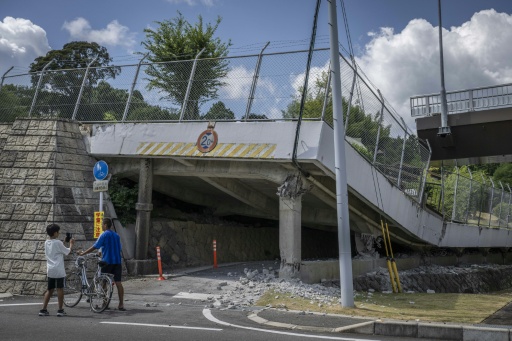
The tremor on the island of Kyushu caused widespread damage, flattening homes, triggering fires and leaving left tens of thousands of residents without power and water.
Akio Yoshida, the president of mall operator Aeon, said three people died at the facility in the town of Kashima, with one more fatality feared and three others missing.
"The cause is still being investigated, but it's likely that gas caused it," fellow Aeon executive Keiji Ohno told a news conference where he and others bowed in apology.
Five people were also confirmed killed and four others were unaccounted for at the Nippon Paper Industries factory in Yatsushiro city, where part of a red-and-white smokestack collapsed, a government official told AFP.
"Extensive damage has been confirmed, including casualties, collapsed buildings, fires and damage to roads," Prime Minister Sanae Takaichi said in Tokyo as she announced 13 fatalities, describing a "race against time" to help those affected.
Government spokesman Minoru Kihara said that as of early Wednesday more than 9,000 people had sought refuge in 506 shelters in three regions of Kyushu island.
Around 130 police, 450 firefighters and 170 military personnel were involved in the rescue operation at the Aeon Mall Kumamoto, he said.
Some stunned locals said the quake was the biggest they had felt in their lifetimes, measuring at the top of Japan's seven-level shindo scale of shakiness.
"It was the strongest quake I ever experienced," Kanzo Matsumoto, 73, the operator of a luxury onsen hot spring inn in Yatsushiro, told AFP.
"I'm not sure if (the region) will be able to recover from the damage."
Tokito Kitagawa, 21, pulled over at a convenience store when the quake struck as he was travelling in Kumamoto on his motorcycle.
"There was a sudden big noise," Kitagawa told AFP. "I couldn't stay standing. I had to crouch down. Then all the cup noodles fell all over me on the floor."
One user on X who said that they worked inside the mall recounted the moments after the quake hit.
The user with the handle Palan said staff had guided customers outside and then some employees went back to get their belongings.
"Since there didn't seem to be any smoke inside the premises from what we could see, we felt reassured," they said. "Then an explosion occurred."
Footage from inside the mall showed rescue workers in orange overalls and white helmets picking their way through a mass of twisted steel, dangling cables and chunks of ceiling.
Initial reports had said that as many as 20 to 30 people were trapped inside.
Some 31,200 households and facilities still had no power on Wednesday morning, while 84,000 homes were suffering water disruptions, officials said.
TV footage showed people queueing for petrol and drinking water.
The powerful tremor, which struck at 4:27 pm (0727 GMT) on Tuesday, knocked over a cargo train, flattened a traditional "torii" gateway and cracked roads, making many impassable.
High-speed shinkansen trains mostly remained suspended on Wednesday.
Footage also showed parts of a wall at the centuries-old Kumamoto Castle collapsing.
The US Geological Survey measured the quake at 6.8, lower than Japan's reading of 7.1.
Japan is one of the world's most seismically active countries, sitting on top of four major tectonic plates along the western edge of the Pacific "Ring of Fire".
Kumamoto was hit by two devastating earthquakes in 2016, which killed 273 people and injured more than 2,800.
The archipelago, home to around 125 million people, typically experiences hundreds of jolts every year and accounts for about 18 percent of the world's earthquakes.
The vast majority are mild, although the damage they cause varies according to their location and the depth below the Earth's surface at which they strike.
Japan is haunted by the memory of a massive 9.0-magnitude undersea quake in 2011, which triggered a tsunami that killed or left missing around 18,500 people and wrecked the Fukushima nuclear plant.
Latest stories
Madrid Vidas en juego
Decenas de migrantes abordan una embarcación de traficantes de personas para intentar cruzar el canal de La Mancha hacia Reino Unido el 29 de julio de 2026 en la playa...

Espanol Cucurella cumple su promesa y se tatúa la cara del seleccionador español
El internacional español Marc Cucurella se tatuó la cara del seleccionador español, Luis de la Fuente, después de prometer que lo haría si España ganaba el Mundial...

Mundo Activistas exigen en Brasil acceso a genéricos de un fármaco contra el VIH
Activistas reunidos esta semana en una conferencia internacional sobre el sida en Brasil exigieron un acceso más amplio a las versiones genéricas de un fármaco prometedor para la prevención del VIH, cuyo costo puede alcanzar...