


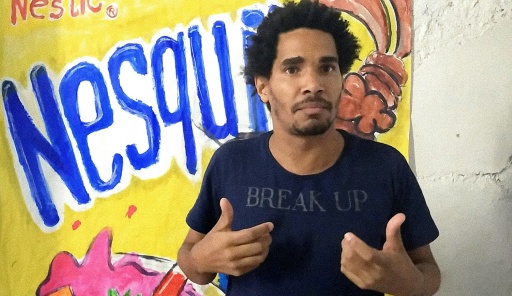
Prominent Cuban dissident artist Luis Manuel Otero Alcantara flew Saturday to exile in the United States after serving a five-year sentence on the island, as Washington urged Havana to release more than 700 political prisoners.
Otero Alcantara, designated a prisoner of conscience by Amnesty International, was sentenced to five years in prison in 2022 for insulting national symbols, contempt and disturbing the public order.
He landed in Miami, the capital of the Cuban diaspora, after a short flight from Havana, according to a video of Otero Alcantara at the airport that was shared with AFP by his friend, activist Anamely Ramos.
Otero Alcantara, a self-taught performance artist, sculptor and painter, rose to prominence in 2020 as leader of the San Isidro protest movement of artists and intellectuals.
Authorities detained him in July 2021 as he left his Havana home to join unprecedented mass protests.
On Saturday he said he would continue working for a free Cuba.
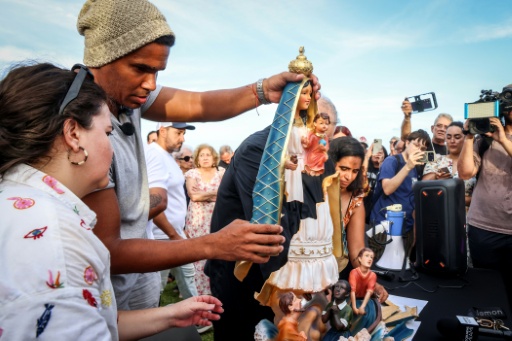
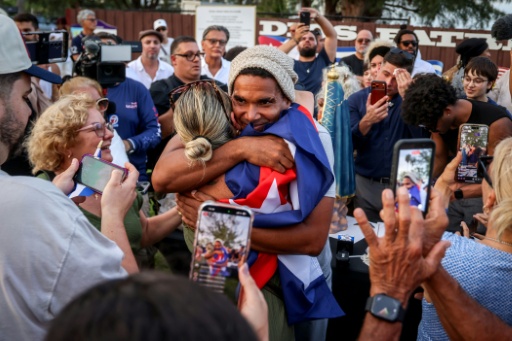
"What's really happening right now is the result of all of our efforts," he told members of the Cuban exile community that had gathered with him as he visited a Miami shrine featuring the patron saint of Cubans.
"What I really want is to work... Every minute I lose is one more minute of dictatorship," said the artist, who has begun to restore a statue he brought from Cuba.
Washington hailed Otero Alcantara's arrival in the US and said Havana imprisoned him "for daring to imagine a free Cuba."
US Secretary of State Marco Rubio said in a statement that "Otero Alcantara's only 'crime' was refusing to stay silent and using his art to demand the basic freedoms everyday Cubans have been denied for almost seven decades."
Rubio also called for Cuba to release the more than 700 political prisoners "unjustly detained" and held by Havana.
"The international community must stop turning a blind eye to the human rights abuses of the Cuban regime and join us in demanding an end to their repression," he said.
- No 'martyr' -
Otero Alcantara is among the most prominent Cuban dissidents. He was awarded the Norwegian Rafto Prize for Human Rights in 2024 "for his fearless opposition to authoritarianism through art."
His Facebook account, operated by his friends, says he was held in Cuba in a maximum security prison, and that a condition of his release was that he never return to the country, which has accused him of acting on behalf of Washington to destabilize the communist-run island.
On July 7, he was transferred from a prison to a state security force facility, two days before completing his term. Authorities provided no information about his whereabouts after that.
The release comes amid major Havana-Washington tensions, with US President Donald Trump mounting a pressure campaign against Cuba.
During a recent UN General Assembly debate on US sanctions against Cuba, US Ambassador Mike Waltz held up a portrait of Otero Alcantara to denounce the island's repressive policies.
The dissident's departure to Miami confirms the Cuban government's strategy of silencing its most critical voices through exile.
According to a tally of human rights organizations, between 700 and 1,000 political prisoners remain jailed in Cuba.
In October, another dissident figure, 55-year-old Jose Daniel Ferrer, went into US exile.
Friends say Otero Alcantara is embracing his newfound freedom.
"Today, Luis wants to live again, resume his projects, and reclaim the time that was stolen from him," reads one of the Facebook posts.
"He also wants to continue envisioning and working toward freedom for Cuba."
Shortly after the artist arrived in the United States, he told supporters that there are "a whole range of tools" to help people "understand what freedoms are and take to the streets for that reason."
In April, Otero Alcantara dictated a guest essay by telephone from jail to a friend, who delivered it to The New York Times.
"I'm allowed to paint. It's what's kept me alive," he said.
"If I couldn't make art, I would die," he added. "That's why the guards let me do it -- so I don't turn into a martyr."
jb-gma/hol/lga
© Agence France-Presse
Latest stories

Mundo La IA ya cabe en el bolsillo: teléfonos de última generación deslumbran en una feria en China
Firmas tecnológicas compiten por lanzar teléfonos que utilizan inteligencia artificial para hacer de todo, desde pedir comida hasta redactar mensajes con...
Mundo Andy Burnham y la probable continuidad en política exterior británica respecto a Starmer
El futuro primer ministro británico Andy Burnham, poco conocido internacionalmente, podría mantener en materia diplomática una línea de continuidad con su predecesor, Keir Starmer, en asuntos como Ucrania o las relaciones con la UE, aunque...

Mundo EEUU lanza nuevos ataques aéreos contra Irán tras la muerte de dos soldados
Estados Unidos lanzó el domingo una serie de ataques para "castigar" a Irán, después de informar las primeras muertes de militares estadounidenses desde que se reanudaron...