
Iran's Guards say tankers exploded from Hormuz mines as US strikes continue


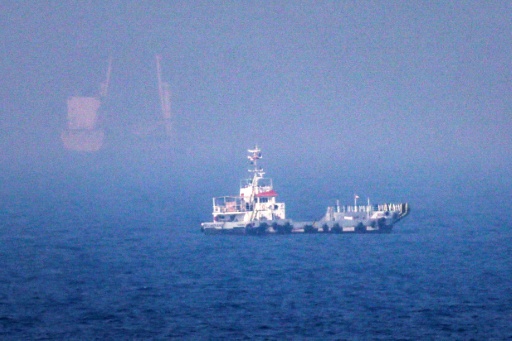
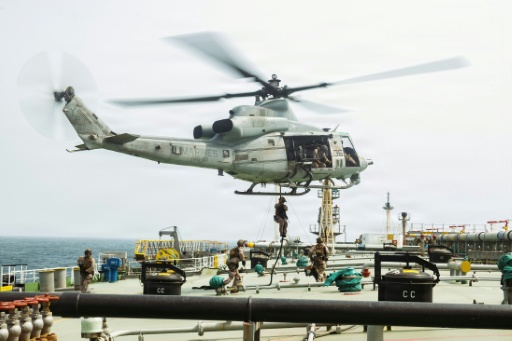
Iran's Revolutionary Guards said Saturday that two oil tankers exploded after hitting mines in the Strait of Hormuz, as the United States and Tehran continued to trade drone and missile strikes.
"An hour ago, two oil tankers, which were trying to pass through the minefield south of the Strait of Hormuz by deceptive American intelligence agencies, exploded and caught fire," the Guards said in a statement published by state news agency IRNA, without identifying the tankers.
The Revolutionary Guards also said on state television they "stopped" four ships trying to transit the critical waterway.
US forces, meanwhile, reported striking Iran for the seventh consecutive night with attacks designed to "continue degrading Iranian military capabilities," according to a statement by US Central Command shared on X.
In the biggest escalation since the foes resumed hostilities, Iran accused US forces of targeting civilian infrastructure, including an airport, a railway station and two bridges, and said it had struck US assets across the region.
US President Donald Trump has previously threatened to hit Iranian infrastructure, but there was no confirmation from the US side on Friday that US forces have begun to do so.
Major General Mohsen Rezaei, a senior military advisor to Iran's supreme leader, said Tehran will resume "full-scale offensive operations" if US strikes against it continue for another two or three days.
"Iran will no longer limit itself to retaliatory, like-for-like responses...and no political border will be safe," Rezaei said, according to the Iranian news agency IRIB.
The war began on February 28 with deadly US-Israeli strikes on Iran, which retaliated by effectively closing the Strait of Hormuz, a vital shipping channel for much of the world's oil, and launching attacks on Israel and American interests across the Gulf.
Iranian Revolutionary Guards aerospace force commander Majid Mousavi said "targeted strikes from across Iran against the enemy will continue" until the US ends operations against Iran's coastal facilities in the south and around the strait.
David Khalfa, a Middle East specialist at the Jean-Jaures Foundation, a Paris-based think-tank, noted that a "widening range of strategic infrastructure" is now being drawn into the conflict.
"The paradox is that, while the conflict continues to escalate, neither side has a strategic interest in allowing this dynamic to continue. Yet both perceive any compromise as a form of capitulation," Khalfa told AFP.
- 'Punish the aggressor' -
Iran's energy ministry urged citizens to reduce their electricity use and switch off air conditioners in peak hours -- even as temperatures in some areas soared -- after the power grid came under strain from what it said were US strikes on energy facilities.
Iran's military had threatened infrastructure across the region in the event of any attacks on its own, and on Friday launched widespread strikes.
In Kuwait, where Tehran said it targeted US military sites, the electricity ministry said an Iranian attack damaged a power and water plant and urged users to ration electricity.
The Kuwaiti military said several troops had been wounded when Iranian drones targeted a number of its bases and camps.
Iran's Guards said they had targeted US radar systems and military aircraft in Qatar to "punish the aggressor", with Doha saying it had intercepted a missile attack.
Iran's Guards said they had attacked two US radar sites in Oman and the Al-Tanf military base in Syria. A Syrian military source denied there had been an attack and US forces said they had withdrawn from the base earlier this year.
- Calls to resume talks -
Jordan's military said it shot down three Iranian missiles.
In Bahrain, Tehran targeted US helicopters and planes at an airbase, Iranian state media reported, with the island nation urging citizens to take shelter.
In Iraq's Kurdistan region, drone and rocket strikes killed nine members of an Iranian Kurdish armed opposition group on Friday, the exiled Komala Party of Iranian Kurdistan said, blaming the attack on Iran.
Iran's health ministry said at least 38 people have been killed and more than 400 wounded in the country since fighting resumed.
Mediators have attempted to bring both sides back to the negotiating table and China and Pakistan called for the US and Iran to stop fighting and resume talks.
As part of the wider escalation, the US has also reimposed its blockade of Iran's ports, and attacks on ships in the Strait of Hormuz have continued with the UK Maritime Trade Operations agency on Friday saying a tanker was struck by a projectile off the coast of Oman overnight.
burs/jgc/msp
© Agence France-Presse
Latest stories
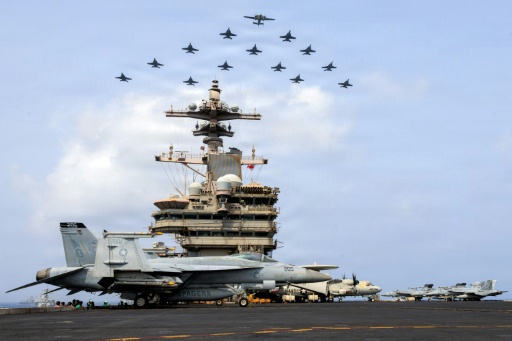
Mundo Irán amenaza con una "ofensiva total" y EEUU continúa sus bombardeos
Irán amenazó el viernes con lanzar una "ofensiva total" mientras que Estados Unidos puso en marcha su séptima noche consecutiva de bombardeos, lo que supone la mayor escalada desde que los dos enemigos volvieron...

Montevideo "España no es solo Lamine", dice Messi antes de la final del Mundial
El astro argentino Lionel Messi advirtió que la fortaleza de España, su rival en la final del Mundial de 2026 el domingo, no se limita...
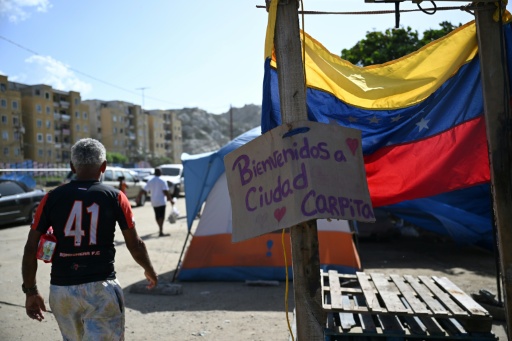
Montevideo "Bienvenidos a Ciudad Carpita": la vida en refugios tras los sismos de Venezuela
"Bienvenidos a Ciudad Carpita", se lee en un letrero junto a una bandera de Venezuela en la entrada de un campamento de damnificados por los terremotos en...