


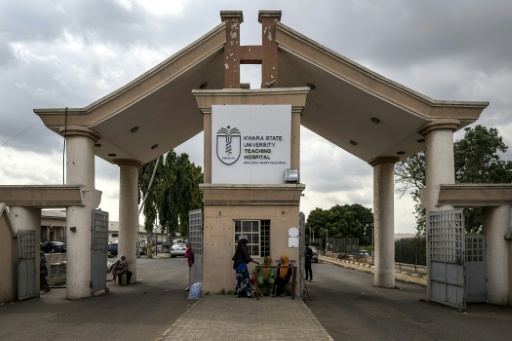
Frail and malnourished children and women lay on rows of hospital beds, their bodies bearing the scars of six months of captivity deep in the Nigerian bush.
The patients were among 163 kidnapping victims rescued this month in the Kainji Lake National Park forest, after their village, Woro, was attacked by suspected jihadists.
In total, 308 people were freed in what the government called the largest single day rescue operation. But at the Kwara State University Teaching Hospital in Ilorin, a long road to recovery lay ahead.
A child lay beneath a blue sheet, hooked to a respirator, with doctors and nurses clustered around the bed.
A sobbing girl, no more than six years old, sat alone on a bed, her family yet to visit.
"They are all responding to treatments," a nurse said, holding the tiny hand of a young boy about four years old. "Some of them still need blood."
Suspected jihadists attacked Woro, near the border with Benin, in February, killing at least 165 people and kidnapping scores.
Abductions have become a key moneymaker for criminal groups in Nigeria, especially among jihadists and non-ideological bandit groups across the north and centre of the country.
The victims were kept at a camp along with more than 100 others seized from other villages, including Kasuwan Daji and Konkoso, both in Niger state, Woro village head Umar Bio Salihu told AFP.
Thirteen people from Woro died in captivity, he said, and 13 more remain in captivity.
Interviews with victims in the hospital were brief and stymied by officials who repeatedly bounced AFP journalists between different offices to seek approval.
The government has touted the rescue of the Woro villagers as a major success in its campaign. But it still faces a crisis as kidnappings have become so rampant across the country that they have become a multi-million-dollar industry, according to SBM Intelligence, a Lagos-based consultancy.
"We thank God we are out," one gaunt victim, Hajara, said. "I do not wish that on even my enemies. It was like we just came back from hellfire."
While being held by the gunmen, the captives were fed tuwo, a thick, porridge-like meal made from guinea corn, and a "soup" made from a mixture of river water and salt. When they were lucky, their captors gave them seasoning cubes.
Occasionally they got beef, from cattle they assume was rustled.
"When they came they were quite bad... severe malnutrition, lots of skin diseases, some had fractures, some mothers have just delivered," the hospital chief medical director, Ahmed Bola Abdulkadir, told AFP, adding many need care for "psychological trauma".
While in captivity, those who went to relieve themselves without the guards' permission were beaten, said 25-year-old nurse Amira Salihu, whose two brothers were killed during the February attack.
The daughter of the Woro village head's gentle smile belied her harrowing experience as she spoke to AFP from a hotel -- guarded by police -- where some freed abductees were staying.
More than a dozen women went into labour while in captivity, Amira Salihu said.
With little visibility -- battery-powered torches being the only sources of light -- she helped to deliver the babies using her bare hands.
"I borrowed a razor blade to cut the placenta," she told AFP.
At the hotel, scores of the victims, mostly young children, noisily gathered around plastic tables in a hall for lunch.
"I am happy seeing them like this," Umar Bio Salihu, the village head, told AFP.
He has been shuttling between Woro and Ilorin, some 200 kilometres (125 miles) away, to check on the victims while they recover under government care in the state capital.
Despite the scale of the tragedy, Woro is coming back to life, a resident Isah Mogaji told AFP, with the village market in full swing.
"The community is very happy now," village head Salihu said. "They are waiting to receive their people."
Latest stories

Sports Liebmann holt Gold mit Europarekord - Schwarz gewinnt Silber
Senkrechtstarter Johannes Liebmann ist seiner Favoritenrolle in Paris gerecht geworden und mit einem Europarekord erstmals zu EM-Gold geschwommen. Der erst 19 Jahre alte Magdeburger krönte sich im Centre Aquatique Olympique in 7:37,59 Minuten sensationell zum ersten deutschen Europameister über die 800 m Freistil und unterbot dabei seine eigene Bestmarke von 7:37,94 Minuten. Dahinter sicherte sich Vizeweltmeister Sven...

Topthemen Totale Sonnenfinsternis taucht Teile Spaniens in Dunkelheit
Eine totale Sonnenfinsternis hat Teile Spaniens am Mittwochabend in Dunkelheit getaucht. Vielerorts versammelten sich tausende Menschen, um das Spektakel zu verfolgen, wie AFP-Journalisten aus Burgos, Tarragona und Colmenar Viejo in der Nähe der Hauptstadt Madrid berichteten. Die totale Sonnenfinsternis dauerte in Lodoso bei Burgos weniger als zwei Minuten. Hunderte...
Sports Schwimm-EM: Elendt und Köhler verpassen Medaille
Weltmeisterin Anna Elendt muss bei der Schwimm-EM in Paris weiter auf ihre erste Medaille warten. Die 24-Jährige verpasste über die 100 m Brust ein Jahr nach ihrem WM-Triumph am Mittwochabend in 1:06,37 Minuten als Siebte das Podium auf europäischer Ebene. Gold ging an die Britin Angharad Evans (1:04,87) vor der Irin Mona...