


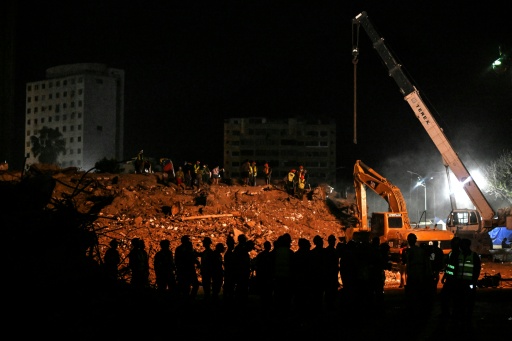
A dangerous cocktail of tectonic positioning, loose earth and shoddy construction contributed to the unprecedented damage caused by Venezuela's twin earthquakes, experts say.
Jennire Garcia's home in the coastal Catia La Mar neighborhood was rendered unlivable by the tremors in late June, which devastated the state of La Guaira.
The 7.2 and 7.5 magnitude quakes killed over 6,300 people and sent 190 buildings crashing down, while 856 more sustained damage.
Garcia and her family are now living in tents next to the ruins, and the 42-year-old says she is "sick with stress all day long."
This was the same site as deadly mudslides that killed thousands of people in 1999.
The region's "unconsolidated" soils, where construction requires specific geotechnical studies, added to the severity of the damage, according to engineer Feliciano De Santis.
"These soils generally tend to be loose soils" and caused the ground to move with even greater intensity, said De Santis, who is president of the Venezuelan Geologists Society.
Garcia's residential complex, which was declared uninhabitable, was built after the landslide.
Deep cracks run through its yellow walls, several balconies have dislodged from the building and some high-rises have crumbled altogether.
Rescuers across the quake zone have not abandoned the search for victims under the rubble, and are working through the debris of buildings up to 12 stories high.
The last adjustment made to earthquake regulations for buildings was in 2019, and before that, in 1967 when a horrific 6.6 magnitude tremor struck the country.
A closer look at La Guaira's infrastructure reveals significant construction flaws, said Japanese engineer Kit Miyamoto, who is touring the state with support from Washington.
For instance, large quantities of steel "seems like it's really good," he told AFP.
"But once you get down to look at how actually the rebar (steel reinforcement) is connected to the foundation, it's not much," the engineer added.
In the early 2010s, the government of late leader Hugo Chavez built 43 flagship social housing high-rise buildings.
The quakes flattened 16 of them, crushing hundreds of residents underneath.
A recent investigation by Armando.info revealed that "contracts awarded at discretion to companies whose experience was unknown" fueled the damage.
In Caracas' worst-hit neighborhood Chacao, 68 people died while three buildings collapsed and dozens more are uninhabitable.
Most of these buildings were constructed before the 1967 earthquake, Venezuela's Engineering Order said.
"Some had been reinforced," said organization representative and engineer Felix Ojeda, adding that rubble samples taken on site can provide clues about the state of the infrastructure.
"The obvious next step," said Miyamoto, "is to take down the buildings," adding that retrofitting and strengthening buildings was also important to do as much as possible.
Public fury about the government's slow response to the quakes is widespread.
Interim leader Delcy Rodriguez -- who effectively governs under Washington's thumb since her predecessor Nicolas Maduro's ouster -- has promised to deliver around 4,000 housing units this year.
Back in Catia La Mar, Garcia pines for her former home.
"It makes me sad because I see it there every day. I think about the comforts I had and that I can't have here," she said.
"We are so anxious," she said, "waiting for an answer, and we don't have one."
Latest stories
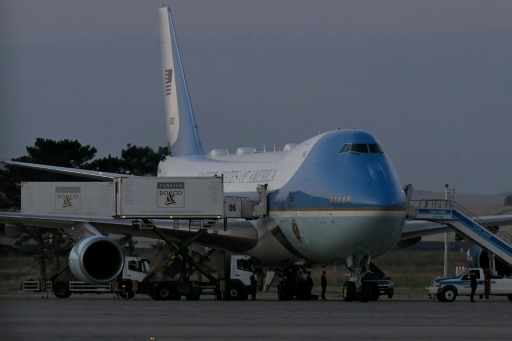
Topthemen Trump bestätigt heimlichen Flugzeugwechsel bei Abflug von Nato-Gipfel in Ankara
US-Präsident Donald Trump hat Berichte bestätigt, dass er kurz vor dem Abflug vom Nato-Gipfel in Ankara auf dem Flughafen der türkischen Hauptstadt heimlich die Maschine wechselte. "Sie wollten, dass ich einen anderen Flug nehme, ein anderes Flugzeug", sagte Trump am Dienstag offensichtlich mit Blick auf seine Personenschützer. "Sie wollten es so...

Topthemen Warken verteidigt Geheimdienstreform - Scharfe Kritik von Kubicki
Vor der geplanten Verabschiedung der Geheimdienstreform durch das Bundeskabinett hat Kanzleramtschefin Nina Warken (CDU) die Pläne verteidigt: "Das Kabinett legt an diesem Mittwoch den Grundstein für die umfangreichste und grundlegendste Reform der Nachrichtendienste seit ihrem...
Weltgeschehen Schranke hochgehoben und weitergefahren: Britische Mautsünder in Frankreich ertappt
Sie hoben die Schranke hoch und fuhren ohne zu zahlen weiter: Eine britische Familie hat in Frankreich monatelang keine Autobahnmaut gezahlt. Nun flog ihr Vorgehen aber an einer Zahlstation im Osten des Landes auf...