


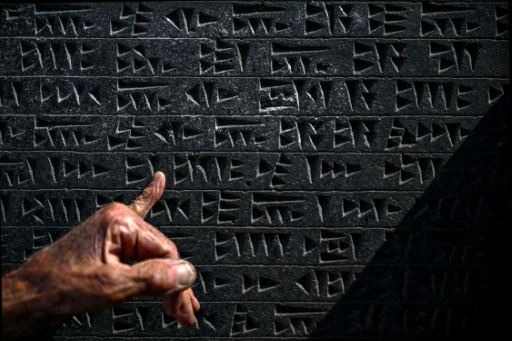
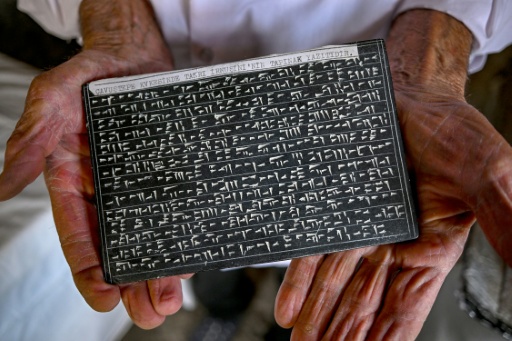
Mehmet Kusman did not spend very long at school, but he traced the ancient inscriptions chiselled into the black basalt rock and read: "Before me there was nothing. But by the power of the god Haldi I founded this city."
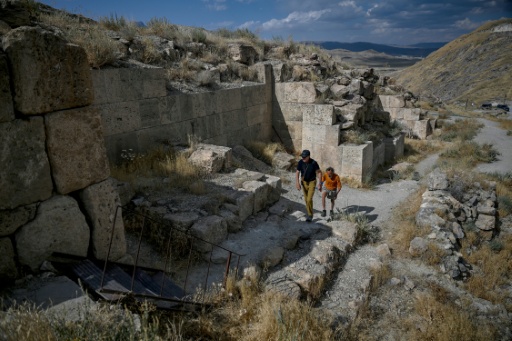
Kusman, 86, has dedicated his life to the fortress of Cavustepe in eastern Turkey, and to learning the language of the vanished kingdom of Urartu, to honour its forgotten gods and rulers.
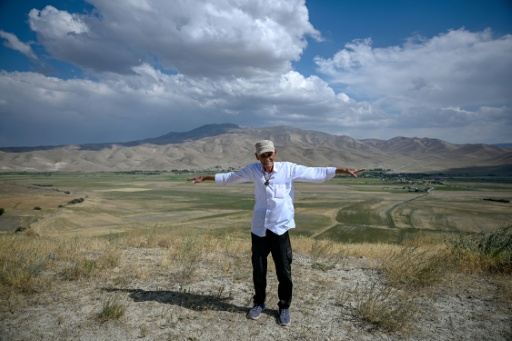
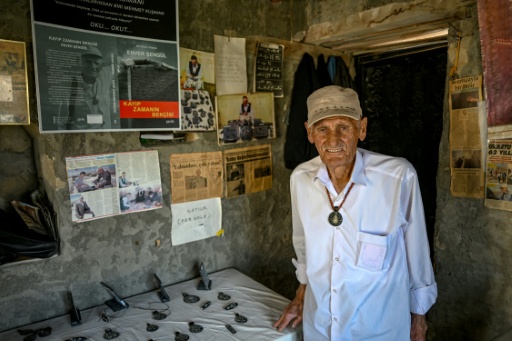
Brisk of step and sharp of mind despite his years and the hot winds that whip the castle, he stood at the foundations of a temple dedicated to Haldi, the warrior god of gods. Kusman wore a cap bought in Los Angeles on which he has written "USA 2009" in the cuneiform script typical of the region's ancient civilisations.
Kusman was hired as a labourer on the Cavustepe excavations after his military service in the 1960s and there encountered his first stele.
"The inscription was very beautiful," he told AFP. But the head of the dig discouraged him from learning this "very difficult" script, which borrowed its cuneiform alphabet from Assyrian.
"His telling me 'No' hurt me," he said. "I became relentless, thinking: 'In my lifetime, I will learn it.'"
Despite a lack of formal education, Kusman began copying the inscriptions found during excavations carried out in eastern Turkey, Iran and Armenia, over which Urartu once stretched.
In three years, he said, he mastered the alphabet, but "it took me 22 years to master 650 words" of vocabulary.
Academics contacted by AFP praised Kusman's enthusiasm and devotion. He has become something of a local curiosity, calling himself "one of the last seven people in Turkey to speak the Urartian language."
Erkan Konyar, professor of ancient history at Istanbul University, describes the kingdom as "one of the most powerful states of the ancient Near East, between the 9th and 7th centuries BC."
Urartu -- more recent than the great Mesopotamian kingdoms of Assyria, Sumeria and Babylon -- brought the tribal mountain communities together under a centralised state, building cities, fortresses, irrigation networks and vast food storage facilities, Konyar said.
Despite retiring in 2005, Kusman continues to watch over Cavustepe, said Konyar, a specialist on Tuspa, the kingdom's founding capital.
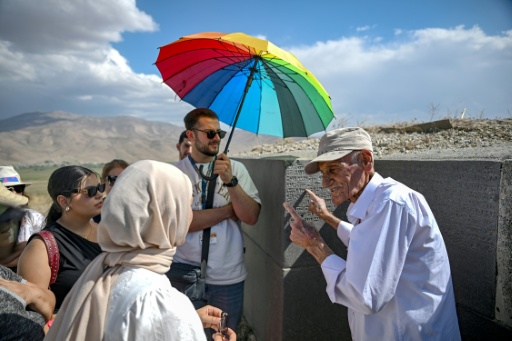
"For 60 years, he has lived amid the excavations and introduced thousands of visitors to the history of Urartu."
But Konyar is careful to qualify Kusman's claims to speak the language. In fact, historians do not really know how it was pronounced, he said.
"The available inscriptions allow us to understand it up to a certain point, but we lack vocabulary and texts," he said. "Only the meaning of certain words is known with certainty. So no one can claim to speak Urartian."
"Even in the time of Urartu, people did not speak this language; it was only written," said Mehmet Isikli, director of the Department of Near Eastern Archaeology at Ataturk University in Erzurum.
Kusman's passion for the language has made him a local celebrity. His lectures have taken him "to America, five times, to Germany, the Netherlands, Belgium," he said, reeling off the list with a touch of showmanship.
"Now, I'm thinking of going to Japan," he added.
Isikli is excavating the fortress of Ayanis, the last of the great strongholds built in the kingdom before it collapsed, 35 kilometres (22 miles) north of Van, with a commanding view of the lake.
"Our excavations may tell us something about the end of Urartu," he said, noting that researchers have found "the traces of a very powerful earthquake."
Isikli admits to a certain respect for the old guardian.
"I admire him," he added. "He has worked hard and brought Urartian culture to light.
"Mehmet Kusman provides a sort of publicity for Urartu, but it has nothing to do with academic work: he knows only a few alphabetical signs, or a few letters, and some very, very general information about them."
In his small stone hut at the entrance to the Cavustepe site, Kusman is undaunted by the doubters.
"I am a descendant of the Urartians, their grandson," he said. "They disappeared, but look, they are not all dead," he declared, as he stood to welcome visitors.
Latest stories

Deutschland Frontalzusammenstoß in Mecklenburg-Vorpommern: Zwei Tote und drei Schwerverletzte
Bei einem Frontalzusammenstoß auf einer Bundesstraße in Mecklenburg-Vorpommern sind zwei Menschen ums Leben gekommen. Drei weitere wurden schwer verletzt, wie die Polizei in Neubrandenburg am späten Sonntag mitteilte. Eim 86-jähriger Autofahrer bog laut Polizeiangaben auf der B198 in Höhe der Abfahrt Ganzlin nach links ab und missachtete dabei den nahenden Gegenverkehr...

Deutschland Lastwagen und Motorrad kollidieren: Zwei Tote bei Verkehrsunfall in Rheinland-Pfalz
In Rheinland-Pfalz sind bei einem schweren Verkehrsunfall zwischen einem Lastwagen und einem Motorrad zwei Menschen ums Leben gekommen. Der 38-jährige Fahrer des Motorrads und sein 33-jähriger Mitfahrer starben noch an der Unfallstelle an ihren schweren Verletzungen, wie die Polizei in Linz am Rhein am späten Sonntag mitteilte...
Topthemen Westeuropa erlebt heißesten Juni und Juli seit Beginn der Aufzeichnungen
Westeuropa hat in diesem Jahr den heißesten Juni und Juli seit Beginn der Aufzeichnungen erlebt. Die Durchschnittstemperatur für die beiden Monate lag bei 21,62 Grad – und damit über dem bisherigen Höchstwert aus dem Jahr 2022, wie das EU-Beobachtungsprogramm Copernicus am Montag mitteilte. Der Wert spiegele "die außergewöhnlich anhaltende Hitze" in diesem Sommer wider, erklärte Copernicus. Die Bodenfeuchtigkeit sei zudem "deutlich...