


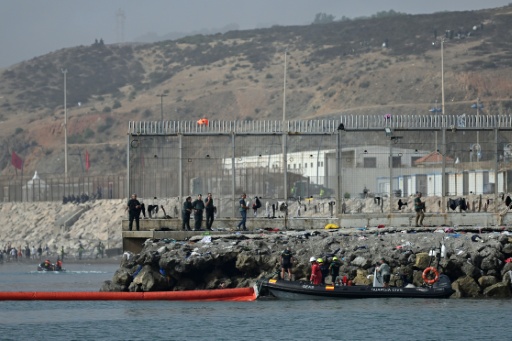
In dirty t-shirts and flimsy sandals, hundreds of unaccompanied minors slept outdoors in a disused industrial park in Ceuta after swimming to the Spanish territory from Morocco, AFP saw Saturday.
Wandering in the heat between the red and yellow walls of abandoned warehouses, teenagers approached and said they had hardly eaten for four days.
They were among tens of thousands of migrants who crossed into Cueta, most swimming around the small border post that juts into the Mediterranean Sea, in an unprecedented surge that triggered an international crisis for Spain.
Most of those arrivals have been sent back to Morocco but crowds of the youngest ones lingered, saying they hoped to make it to mainland Europe.
"Morocco, no! Spain," several of them called out, explaining why they had made the dangerous sea crossing.
One gripped the badge of his red Spanish football shirt and cried: "Viva Espana!"
One approached insistently and said he was 14 years old and had come alone with no adults or older companions to accompany him.
He pointed to a pile of litter and flattened cardboard boxes on the concrete ground where he said he was sleeping at night.
AFP does not solicit testimonies from unaccompanied minors nor identify them, under its ethical code.
Inside one warehouse reeking of unwashed bodies, minors milled around on a floor covered in water and mud, some showering with water from a single hosepipe.
Others dozed on the pavements outside. One, who said he was aged 17, pointed out an improvised structure of bars and pallets where he and his friends had been sleeping.
No police or other authorities were visible at the site, but private security guards blocked access to one warehouse, thought to house other young migrants.
A sign on that building indicated it was operated by the SAMU Foundation, a humanitarian charity, and the Ceuta regional government.
Workers in charge of that site declined to comment to AFP.
Elsewhere in the fenced-off city, Spanish soldiers ushered hundreds of other migrants, mostly young men and youths, through Ceuta's palm-lined streets to the border to return to Morocco.
Article 35 of Spain's 2000 law on foreigners' rights states that when police identify an undocumented and unaccompanied migrant suspected of being a minor the latter is to receive "immediate attention" from child protection services.
The courts then decide whether a child can be returned to the country of origin depending on family circumstances.
One of the few adults encountered among the crowds sheltering in the shade of the warehouses, Aziz Dabch, 41, told AFP in broken French that "all the children here want to go to (mainland) Spain."
He came from the Moroccan town of Kenitra with his wife and two daughters.
"No one" is looking after the unaccompanied minors at the site, said his 17-year-old daughter, sitting next to him.
"There is no food. We have not eaten today."
Another of the rare adults among the migrants camped out in the complex, a woman of 45, sheltered nearby, her face burned red by the sun.
"There are lots of minors. I don't see anyone looking after them," she told AFP.
She declined to identify herself as she was in an irregular situation, having swum to Ceuta by sea with her husband and daughter.
"There is a catastrophic lack of hygiene -- smells, rubbish," she told AFP.
Around 60,000 migrants arrived in Ceuta over the course of two or three days this week, according to an estimate by the head of the local government, Juan Jesus Vivas.
The Spanish interior ministry put the figure at 50,000.
At least 67 of them died while attempting the swim to Ceuta, according to Interior Minister Fernando Grande-Marlaska.
Vivas called it a "total humanitarian and social emergency", in comments broadcast on Thursday.
"We want to get to Spain and work there, because of the poverty" in Morocco, said the 45-year-old woman, who came from Tangiers.
"Someone should take care of the minors, let them wash, give them clothes and food and somewhere to sleep."
Spokespeople for the Ceuta government and the central government delegation in the territory did not respond to calls on Saturday to comment on the issue.
Latest stories

Sports EM: Wesemann gewinnt Gold vom 1-m-Brett
Wasserspringer Moritz Wesemann hat bei der Schwimm-EM seinen Titel vom 1-m-Brett erfolgreich verteidigt und für die erste deutsche Goldmedaille in Paris gesorgt. Der 24-Jährige aus Halle krönte sich am Samstagabend mit 431,45 Punkten erneut zum Europameister. Kurz zuvor hatten die Turmspringerinnen Pauline Pfeif und Elena Wassen dem DSV-Team...

Topthemen Ceuta-Krise: SPD-Chef Klingbeil fordert Solidarität mit Spanien
Nach der Ankunft zehntausender Migranten in der spanischen Exklave Ceuta hat der SPD-Vorsitzende Lars Klingbeil Solidarität mit Spanien gefordert. Das in Nordafrika gelegene Ceuta sei "Ziel einer offenbar gesteuerten Migrationsbewegung" geworden, erklärte Klingbeil am Samstag in Berlin. Die Menschen seien instrumentalisiert worden "in dem Versuch, Europa zu spalten". Deshalb stehe "die...

Sports Wolfsburg gibt auch Koulierakis ab
Bundesliga-Absteiger VfL Wolfsburg hat den griechischen Nationalspieler Konstantinos Koulierakis ins Ausland ziehen lassen. Wie die Niedersaschen am Samstag bekannt gaben, läuft der Defensivspezialist künftig für die AS Rom in der italienischen Serie A auf. Über die Transfermodalitäten machten die Wölfe keine Angaben, laut Informationen der Bild kassierte der Klub...