


In a small square in central London, Kevin was hawking copies of the Big Issue, a charitable magazine sold by homeless street vendors.
"It keeps me going," he said. "I don't need to go to handouts and ask for free food."
Kevin, 60, has been homeless since being released from prison in 2010 and is sceptical about new Prime Minister Andy Burnham's pledge to "end rough sleeping".
"I think it's meaningless because he's come from Manchester and he hasn't solved it there," he said, referring to Burnham's same goal as mayor of Greater Manchester.
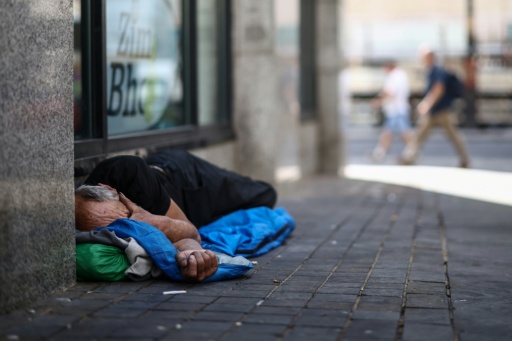
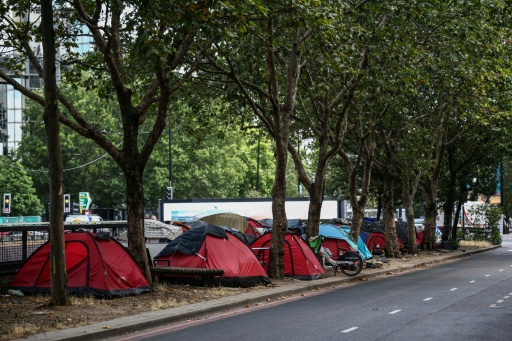
Kevin now lives in a tent, so is officially classed as a rough sleeper.
Asking not to give his full name, he said indoors is not always better.
"I've been in three different hostels in central London and I wouldn't put my dog in one of them. It was disgusting. You'd see needles all about."
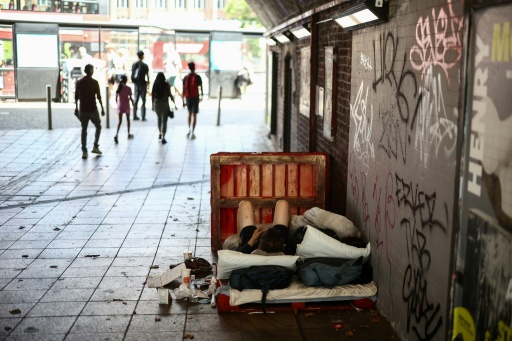
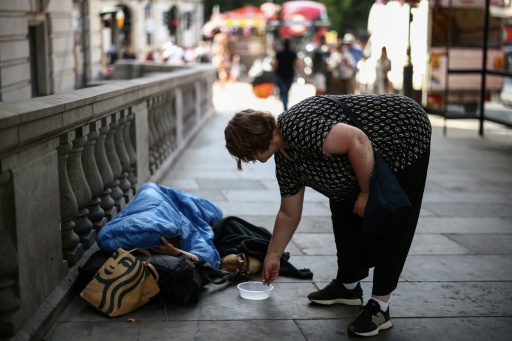
The number of rough sleepers in England reached a record 4,793 in 2025, according to government figures.
It shows little sign of budging, with the Institute for Public Policy Research (IPPR) think tank warning earlier this year the figure could increase by 25 percent by 2030.
Rough sleepers -- those sleeping outdoors -- are a minority of England's total homelessness, estimated at 382,000 in 2025 by leading charity Shelter. This larger figure includes those lacking a permanent residence or security of tenure, and includes families and children.
Local governments, legally responsible for rough sleepers, have struggled under strained budgets and debts, leading to cuts in services.
Charities such as the Hackney Night Shelter are stepping in. They provide some 20 people a bed without charge for up to two weeks.
Grey strip blinds in the dormitories recall the building's past as offices, but the charity has made the space seem more homely.
Director Mark Palframan, 61, who has worked in the sector since the 1980s, thinks Burnham's plan is feasible.
"It's a realistic target," he said, adding resources remain key.
But there is a worrying new trend: many homeless people have jobs.
"Some of these folks really shouldn't be homeless," he said. Previous guests at the shelter include teaching assistants and those working in the film industry.
Work "used to be a route out of homelessness", Palframan said.
Addressing the cost of living, changing rent rights and speeding up asylum processes could help, he argued.
Lithuanian Eddie, 46, has worked for half of the 20 years he spent in Britain. Yet he still found himself sleeping rough.
Dressed in military fatigues, he readied for another night outdoors in London borough Hackney.
"I worked for a removal company. When they didn't pay ... I couldn't (afford) rent, so I lived in the same truck I was using (for work)," he said.
Disabled and receiving welfare payments, Eddie lived in a squat which was closed after squatting in abandoned residential buildings became illegal in 2012.
Now Eddie is "sleeping rough in the bushes".
"There are empty buildings ... why not let people live there?" he asked.
London charity Street Storage provides storage space for people experiencing homelessness, with many of their clients having full-time jobs.
There was even a chef who used the service.
"He stored his chef whites here and his chef knives here, slept outside during the day, collected them in the evening, did a night shift ... then dropped them back here in the morning," said CEO Rachel Woolf.
Jordan Forbes, also at Street Storage, welcomed Burnham's vision, but warned it would not be easy.
"It's all very well getting people off the streets ... but they might not be ready for it."
Reducing homelessness is central to ex-Greater Manchester mayor Burnham's brand.
In 2017, he announced the "A Bed Every Night" scheme in Manchester which reduced the number of rough sleepers from 268 that year to 90 in 2021, according to local authorities. But the figure rose again to 197 in 2025.
On his first day as prime minister, Burnham pledged £340 million ($453 million) to get people off British streets, without setting a timeline or making any concrete proposals.
"Will that £340 million alone solve rough sleeping?" asked IPPR researcher Maya Singer Hobbs asked. "No. It is undeniably going to be expensive in the short term to solve this," she said. But "it is possible".
Building more social housing is essential, requiring a big "upfront investment" that would "save money" long-term.
This could cost "billions" so don't expect announcements until the government produces a budget later this year, Hobbs warned.
Latest stories

Deutschland Verband kritisiert Unterfinanzierung von Essen in Pflegeheimen
Mehr Geld für die Verpflegung der Bewohnerinnen und Bewohner von Pflegeheimen hat der Verband Deutscher Alten- und Behindertenpflege (VDAB) gefordert. "Frische und ausgewogene Ernährung ist ein wesentlicher Bestandteil guter Pflege und darf kein Sparposten sein", sagte VDAB-Bundesgeschäftsführer Thomas Knieling den Zeitungen der Funke...

Wirtschaft Weniger Stellenabbau: Arbeitsmarkt stabilisiert sich laut Ifo-Institut leicht
Die Unternehmen in Deutschland planen nach Ifo-Angaben, etwas weniger Stellen abzubauen. Wie das Münchener Forschungsinstitut am Mittwoch mitteilte, stieg das Ifo-Beschäftigungsbarometer im Juli auf 93,0 Punkte, nach 92,2 Punkten im Juni. "Der Arbeitsmarkt stabilisiert sich etwas, bleibt aber in schwierigem Fahrwasser", erklärte Ifo-Umfragenleiter...

Deutschland 42-Jähriger attackiert Radfahrerinnen - Frau erleidet womöglich bleibende Schäden
Ein 42-Jähriger hat in Kahla in Thüringen zwei Fahrradfahrerinnen auf offener Straße angegriffen und einer von ihnen womöglich bleibende Verletzungen zugefügt. Die 64-Jährige habe Brüche im Gesicht davongetragen und laut Erstdiagnosen eine mögliche Gehirnblutung erlitten, teilte die Polizei in Jena am Mittwoch mit. Zudem bestehe der Verdacht auf...