




A convoy of World Food Programme (WFP) trucks trundles up a winding road along the Venezuelan coast, leaving the quake-leveled town of Catia La Mar far behind.
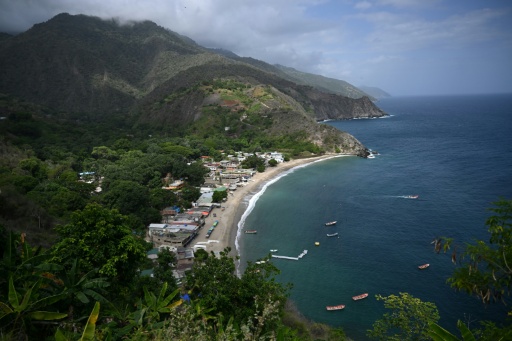
They are heading for the remote village of Chichiriviche de la Costa, which escaped the twin disasters on June 24 relatively unscathed but has seen its resources cut off in the fallout.
Steep ascents, hairpin bends and stretches of unpaved road have added to the difficulties facing this tourist town, whose visitors have unsurprisingly stopped visiting while fish sales have stalled.
The 7.2 and 7.5 magnitude quakes shattered the coastal state of La Guaira, killing at least 5,069 people and causing hundreds of buildings to crumble.
Chichiriviche's population of barely 2,000 received humanitarian aid from the Netherlands via helicopter in the days following the disaster.
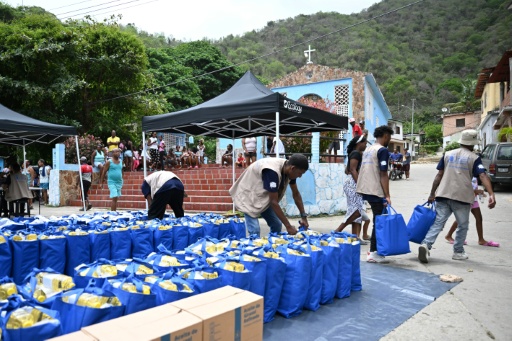
AFP visited the village on Thursday, when the WFP was distributing supplies to villagers on the main square as part of a three-month program worth $80 million.
"Thank God, there were no deaths, but there are some minor shortages," said Andreina Liendo, 54.
"We're receiving a bit of aid, and that's how we manage to survive," she added, accompanied by her four-year-old son Andres as she collected around 50 kilograms' (110 lbs) worth of rice, pasta, flour, oil, salt and more.
These supplies are supposed to last the month and were part of some 25 tons distributed among 498 families in one day.
The United Nations organization will provide around 500,000 tons of food to remote areas and the makeshift shelters that have sprung up across the quake zone.
- 'No income' -
"Our objective today is to help this community get over that period of time where they won't have any income and make sure that they can meet their essential food needs," WFP emergency coordinator Marc-Andre Prost told AFP.
As most attention focuses on the worst-hit areas such as La Guaira, he said, "it is important that we pay attention to these communities in the first days and the first weeks after the earthquake."
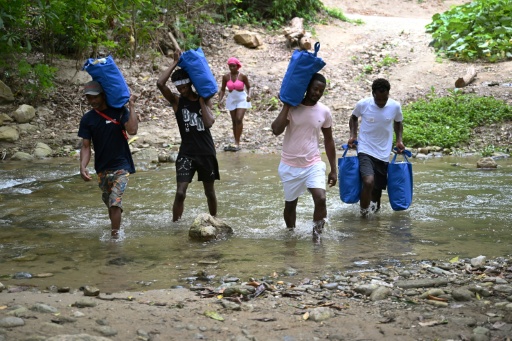
Wilfrank Liendo, 40, and his 21-year-old son, Eduardo, are barefoot as they cross a stream and follow simple dirt paths to deliver the heavy bags to Wilfrank's elderly mother.
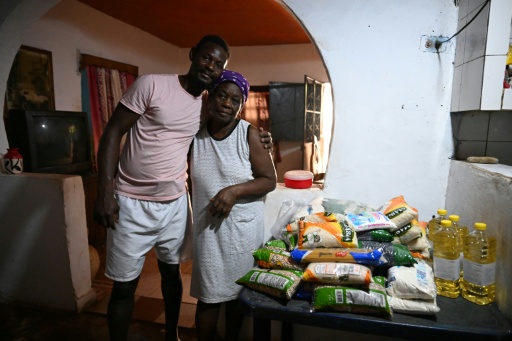
Five people live with widow Margarita Mayora, 79.
The food "lasts me quite a long time, since there aren't many of us," she told AFP as she sorted through the donations.
Some of Mayora's ceilings show cracks from the quakes, and she admits that she has taken to sleeping on the porch out of fear of another disaster.
Her son says he can't stop worrying about the future.
"We live off tourism. If the tourists don't come, we're in trouble," he said.
"I'm a farmer. We have no income, we have no one to whom we can sell what we produce."
- Survival -
Leida Bello, meanwhile, hauls her supplies home alone, where some walls are cracked and one has even collapsed.
"I don't have the means" to repair it, the 45-year-old cleaner said, voicing sadness about the loss of human life Venezuela has suffered.
"We have to survive, find a way to live," she said.
Adalberto Maypora, a well-known character around town, inspects his fishing boat on a deserted beach nestled between cliffs.
Fishermen continue to work at sea, giving the catch to villagers as well as people displaced by the quakes, he told AFP, adding that authorities are covering the fuel costs.
"There's no cash," the 70-year-old said. "If the tourists don't come here, who are we supposed to sell the fish to?"
Maypora remains chipper despite losing many loved ones to the tragedy.
"Let's hope things get better," he said, warning that those who enjoy eating a hearty breakfast will have to reduce their intake.
"No more gluttons, that's over," he said. "We have to ration food."
pgf/ms/cc/pnb
© Agence France-Presse
Latest stories

Topthemen Dobrindt warnt vor verschärfter Sicherheitslage in Deutschland
Bundesinnenminister Alexander Dobrindt (CSU) warnt vor einer verschärften Sicherheitslage in Deutschland. Er habe sich dadurch veranlasst gesehen, "die bislang formulierte abstrakte Bedrohungslage zu einer hohen Bedrohungslage hochzustufen", sagte Dobrindt der "Welt am Sonntag". "Das bedeutet, dass in Deutschland jederzeit mit...

Sports De la Fuente zur Halbzeitshow: "In 30 Jahren Normalität"
Spaniens Nationaltrainer Luis de la Fuente kann der Aufregung um die Halbzeitshow beim WM-Finale nichts abgewinnen. "Ich glaube, dass all das, was wir heute noch als seltsam oder ungewöhnlich empfinden – also Trinkpausen, die 30-minütige Halbzeitpause – vielleicht in 30 Jahren zur Normalität gehören wird", sagte er vor dem...
Topthemen Iran meldet "Explosion" von Öltankern in Straße von Hormus - USA dementieren
In der Straße von Hormus scheint die Lage immer weiter zu eskalieren: Die iranischen Revolutionsgarden erklärten am Samstagmorgen, dass sie mit einem "kombinierten Raketen- und Drohneneinsatz" vier Schiffe gestoppt hätten. Zudem seien in der Meerenge zwei Öltanker auf Minen aufgefahren und "explodiert" - dies dementierte aber die US-Armee. Sie meldete zugleich ihrerseits neue Angriffe auf militärische Ziele im...