


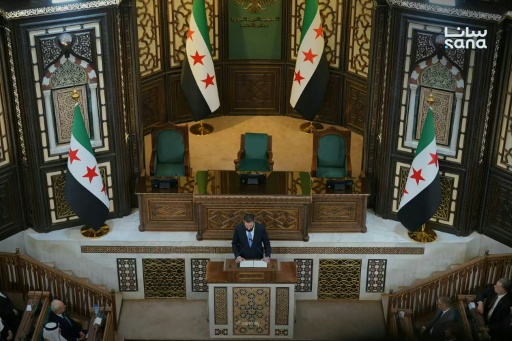
Syria's transitional parliament began its first session on Sunday, state television reported, tasked with drafting the country's new constitution and laying the groundwork for democracy after decades of authoritarian rule.
Syria's new authorities dissolved the country's rubber-stamp legislature after toppling longtime ruler Bashar al-Assad in December 2024, and adopted a temporary constitutional declaration to cover a five-year transition period.
In October last year, and in a process criticised as undemocratic, local committees appointed by the electoral commission -- which in turn was appointed by President Ahmed al-Sharaa -- began selecting two-thirds of the 210 members of the new parliament.
Sharaa appoint the remaining third, 70 members this week.
The session began on Sunday with 206 members, excluding the Druze-majority Sweida province in the south and a deceased member.
Sweida still has not designated its members following sectarian bloodshed there last year, though Sharaa appointed two representatives from there.
The selection process was held in formerly Kurdish-run areas of the north and northeast earlier this year, after the Damascus authorities assumed control there and signed a deal on integrating Kurdish institutions into the state.
Representatives were sworn in, and are expected to elect the assembly's presiding body later on Sunday.
In his opening remarks, Sharaa called on lawmakers to be "models of responsibility and competence, and to contribute to establishing a culture of dialogue, the rule of law, and respect for institutions", adding that his country was writing "a new chapter in its history".
During its renewable 30-months mandate, the parliament is expected to undertake several tasks, most notably forming a committee to draft the constitution, approving the budget, and proposing and amending laws, amid major challenges related to the legislature's independence and the separation of powers, according to analysts.
Syrians have criticised the mechanism for forming parliament, citing the absence of direct elections and the underrepresentation of women.
Civil society organisations have also decried the concentration of all executive power in the hands of Sharaa, amid the absence of a prime minister.
The underrepresentation of Syria's various religious and ethnic groups was also criticised.
lk/nad/jsa
© Agence France-Presse
Latest stories
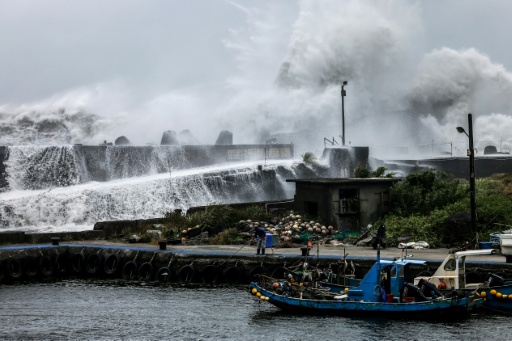
Weltgeschehen Taifun "Bavi" schwächt sich über China ab - Überschwemmungen und Verkehrsbehinderungen
Der Taifun "Bavi" hat sich nach seiner Ankunft im Osten Chinas am Sonntag zu einem schweren Tropensturm abgeschwächt, aber weiter für heftige Regenfälle und starke Verkehrsbehinderungen gesorgt. Fast zwei Millionen Menschen waren zuvor in Sicherheit gebracht worden. Berichte über Todesopfer...
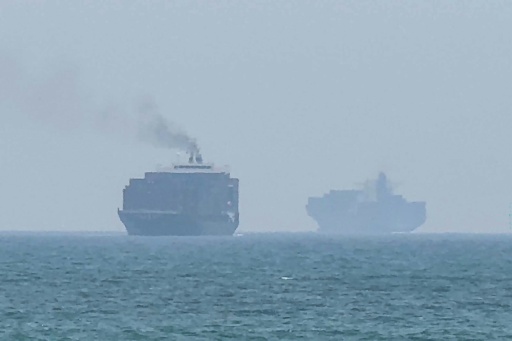
Topthemen US-Armee: Schiffsverkehr durch Straße von Hormus fließt weiter
Trotz der Verkündung des Iran, die Straße von Hormus bis auf Weiteres zu schließen, fließt der Schiffsverkehr durch die für den Welthandel wichtige Meerenge nach Angaben der US-Armee weiterhin. "Der Iran kontrolliert die Meerenge nicht. Der Verkehr fließt", erklärte das...
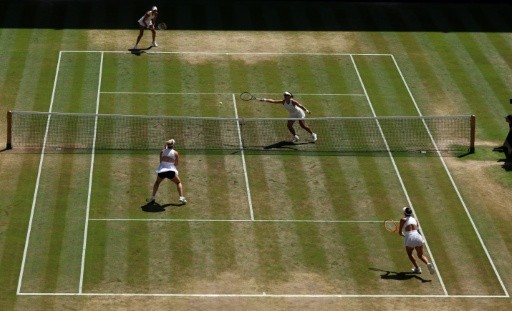
Sports Wimbledon: Doppeltitel für Mladenovic und Guo
Die Französin Kristina Mladenovic hat ihren siebten Grand-Slam-Titel im Doppel gefeiert. An der Seite der Chinesin Guo Hanyu gewann die 33-Jährige das Finale von Wimbledon gegen die Kanadierin Gabriela Dabrowski und Luisa Stefani...