
Nepal glacier saw exceptional heat before collapse caused deadly floods: researcher


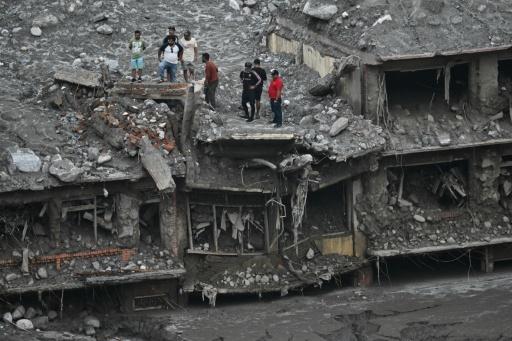
The mountain section whose collapse triggered fatal floods in Nepal and China on August 26 had experienced unprecedented heat for the time of year, meteorological data analysed by a researcher shows.
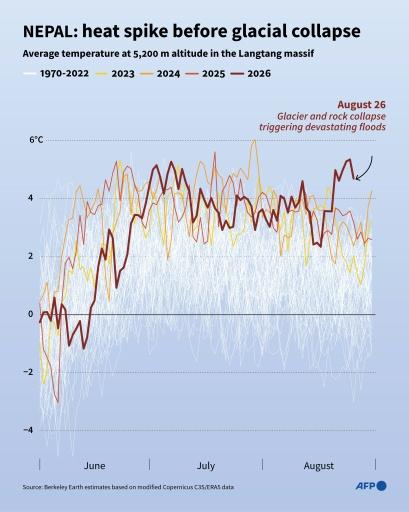
Average temperatures on the mountain glacier at an altitude of 5,200 metres (17,060 feet) were estimated at around five degrees Celsius between August 21 and 26.
This is exceptionally high.
They had not exceeded 4.0C over the same period in more than 55 years of data recording, although no direct link to the collapse has so far been established.
This series of highly localised temperatures was reconstructed by Robert Rohde, chief scientist at the independent Berkeley Earth organisation in California.
At the site of the collapse, the average temperature recorded over that six-day period has risen by about 1.8C since the mid-20th century.
Without the additional heat brought by climate change, a comparable temperature pattern "would probably occur only once in a few thousand years", Rohde calculated for AFP.
The collapse came during the Langtang region's fourth-hottest summer on record, according to AFP's analysis of data from Europe's Copernicus observatory dating back to 1970.
"These hot conditions can also explain permafrost thaw and combined slope and glacier collapse," said French climatologist Valerie Masson-Delmotte.
Permafrost acts as ice cement, holding rock faces together. Its degradation makes them more unstable.
Satellite images also showed significant snowmelt in the days before the disaster, providing "a substantial source of liquid water that can infiltrate fractures in the mountain and facilitate landslides", said Etienne Berthier, a glaciologist at France's CNRS research agency.
Experts remain cautious, however, about the precise role played by the heatwave.
"It's not as straightforward as 'high temperature equals collapse,'" Kristen Cook, a geomorphologist at the Grenoble Alpes University in France, told AFP.
"If the temperature acted as a trigger, it seems that it needed to wait until the rock was right at the tipping point of collapse," she added.
Researchers are now examining the small movements observed in the mountain in the years before the collapse and their interaction with changes in temperature.
"Proving the rock near the fracture plane was significantly weakened as a result of meltwater and/or permafrost thaw" would be a "smoking gun" of climate change, according to Rohde of Berkeley Earth.
His temperature analysis used data from the Copernicus programme's ERA5 climate model and a network of 14 high-altitude weather stations located between nine and 140 kilometres (six and 87 miles) from the collapsed glacier.
Latest stories

La Une روبيو يبدأ جولة في أميركا اللاتينية لترسيخ نفوذ واشنطن فيها
يصل وزير الخارجية الأميركي ماركو روبيو إلى كولومبيا الثلاثاء، في أولى محطات جولته في أميركا اللاتينية الرامية إلى دعم القادة المؤيدين للولايات المتحدة...
La Une شكوى في باريس ضد إسرائيل بتهم تعذيب مشاركين في أساطيل مساعدات إلى غزة
تقدّم 26 فرنسيا بشكوى ضد إسرائيل بتهمتي التعذيب وارتكاب جريمة حرب، أمام النيابة العامة الوطنية لمكافحة الإرهاب في باريس، بعد اعتراض أساطيل مساعدات إنسانية إلى غزة كانوا مشاركين فيها، بحسب...

La Une نيكاراغوا تتهم ألمانيا أمام محكمة العدل الدولية بتسهيل ارتكاب "إبادة جماعية" في غزة
اتهمت نيكاراغوا ألمانيا الثلاثاء أمام محكمة العدل الدولية بارتكاب "انتهاكات متعددة للقانون الدولي"، في إطار دعوى تتهم فيها برلين بتسهيل ارتكاب إبادة جماعية في قطاع...